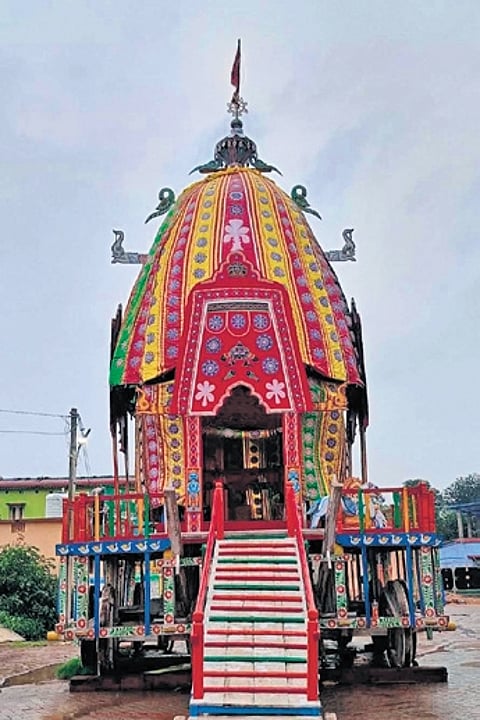

DEOGARH : This year’s Rath Yatra at the 323-year-old Jagannath temple in Purunagar will be significant as the Trinity will embark on their annual journey in a newly-constructed chariot.
Temple priests said as there are no records to indicate when the previous chariot was built, this Rath Yatra will be a landmark event in the shrine’s centuries-old history. The deities will ascend the new chariot on Thursday after the ceremonial Pahandi, marking the beginning of one of western Odisha’s most distinctive Rath Yatra traditions.
The old chariot had become structurally weak over the years, prompting the district administration to facilitate the construction of a new one with support from local donors.
“The old chariot carried immense historical and emotional value, and it was repaired and preserved for as long as possible. However, considering public safety, building a new chariot had become necessary.” said 68-year-old Atulya Kumar Pujari, whose ancestors served as priests at the temple.
Head priest of the temple Santosh Nayak said, “This is an emotional and historic moment for all of us associated with the temple. There is immense excitement among devotees, who are eagerly waiting to witness Lord Jagannath and the sibling deities on the new chariot for the first time.”
Unlike the celebrations in Puri and most other Jagannath temples, the Purunagar shrine observes a three-day Rath Yatra. On the first day, the deities are ceremonially brought out and seated on the chariot, while the actual chariot pulling begins a day later and continues for two days before the deities reach the Gundicha temple.
The Bahuda Yatra also follows a similar pattern, with the return journey completed over two days after the deities are placed on the chariot.
According to temple priests, the Jagannath temple in Purunagar was established in 1703 by then Bamanda ruler Raja Pratap Rudra Dev, who introduced the delayed Rath Yatra so that devotees from the region could first witness the famous chariot festival at Puri before participating in the local celebrations.
The temple also houses the revered ‘Olata Bara’ (inverted banyan) tree believed to have been brought from Puri with the permission of the Gajapati Maharaja.
