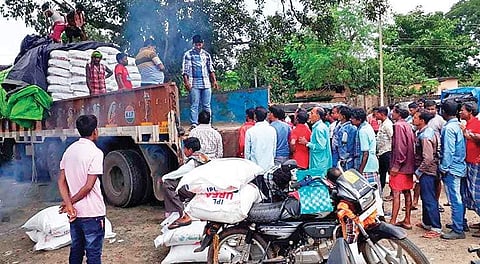

ROURKELA: Even with adequate stocks of fertilisers available, farmers of the rain-fed Sundargarh district are complaining of short supply and enduring long queues to secure the essential agricultural input.
On Tuesday, chaotic scenes were witnessed outside the Regional Cooperative Marketing Society (RCMS) at Sundargarh town as paddy farmers were seen waiting in long queues to get urea and DAP fertiliser.
RCMS president Bimal Patel said to streamline supply of fertilisers, only 60 farmers registered for paddy sale are being provided with a 50 kg bag of DAP and one nano urea packet each daily.
According to official data, Sundargarh’s total fertiliser requirement for the ongoing kharif crop season is around 25,565 tonne. This includes 11,700 tonne of urea, 6,775 tonne of DAP (di-ammonium phosphate), 3,000 tonne of MOP (muriate of potash), 4,000 tonne of NPKS (nitrogen, phosphorus, potassium and sulphur) and 90 tonne of SSP (single super phosphate).
Officials said till Tuesday, available stocks of urea, DAP, MOP, NPKS and SSP were 5,845 tonne, 1,794 tonne, 380 tonne, 2,131 tonne and 124 tonne respectively. So far, 5,055 tonne of urea, 2,607 tonne of DAP, 612 tonne of MOP, 2,781 tonne of NPKA and 69 tonne of SSP have been distributed.
In-charge chief district agriculture officer (CDAO) G Jayan said shortage of DAP is a nation-wide phenomena and Sundargarh is no exception. The district has adequate stocks of other fertilisers and the scenario is much better than other areas. “Instruction has been issued to the MARKFED to send indents for 500 tonne of complex fertilisers as a replacement for DAP. Around 200 tonne of complex fertilisers is likely to arrive soon,” he said.

Sources said 60 per cent of Sundargarh’s total fertiliser requirement is distributed through MARKFED which supplies different fertilisers to 44 large and multi-purpose cooperative societies. In a bid to overcome possible shortage, these societies have been restricted to sell fertilisers only to loanee farmers. The rest 40 per cent of fertiliser requirement is met by three sale points of RCMS, two of OAIC and around 230 authorised private retailers.
Officials said following allegations of private retailers creating artificial shortage, surprise checks were carried out but no wrongdoing could be established. Regulation of supply could be one of the reasons behind farmers complaining about the issue of fertiliser availability, they added.