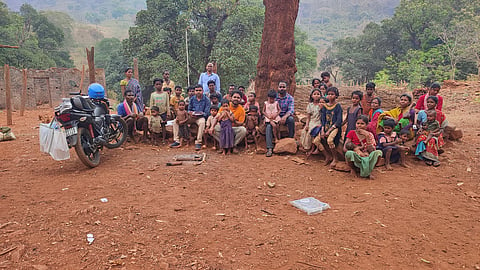

SAMBALPUR: A study by Sambalpur University has found that 68 per cent of children belonging to the Paudi Bhuyan community are malnourished, while 64 per cent of women suffer from anaemia, raising serious concerns over the survival of the Particularly Vulnerable Tribal Group (PVTG) in Odisha.
The study was conducted last year by the Centre of Excellence for Regional Development and Tribal Studies under the university’s department of Anthropology in Sundargarh district. A six-member research team led by professor Arun Kumar Acharya spent nearly six months in the Koida region assessing the community’s socio-economic and health conditions.
In the first phase, researchers surveyed 318 families from among the 1,060 Paudi Bhuyan households spread across Lahunipada, Koida, Bonai and Gurundia blocks. The assessment examined six key indicators - livelihood, nutritional status, health, education, standard of living and cultural identity.
The report found that despite several Central and state government welfare schemes, the living conditions of the Paudi Bhuyan community have shown little improvement. Dependent largely on forests for sustenance, the community continues to rely on food gathering and shifting (podu) cultivation in the hilly terrain.
Researchers attributed the poor health indicators primarily to the lack of nutritious food and safe drinking water. The study also highlighted the absence of adequate healthcare infrastructure in Paudi Bhuyan habitations, with most villages lacking primary healthcare facilities and the nearest primary health centre (PHC) located over 10 km away.
“Nearly 68 per cent of children are malnourished, while 64 per cent of women suffer from anaemia. We also documented a significant burden of diseases such as chronic kidney ailments, malaria and other preventable health conditions,” Professor Acharya said.
He said the findings reflected decades of deprivation and underscored the urgent need for targeted public health and nutritional interventions.
According to the study, the Paudi Bhuyan community remains largely disconnected from the mainstream, with limited access to healthcare, education and other essential services. In the absence of modern medical facilities, many continue to depend on traditional herbal remedies and faith healing for treatment.
“Their livelihoods continue to revolve around subsistence cultivation of paddy and maize, while barter remains a common mode of exchange in several villages. The findings highlight the urgent need for focused interventions to improve their health, nutrition, education and livelihood,” Acharya added.
The researchers warned that unless urgent measures are taken to improve healthcare access, nutrition, education and livelihood opportunities, the Paudi Bhuyan community could face a serious demographic decline in the coming years, putting one of western Odisha’s oldest PVTGs at risk of gradual extinction.
