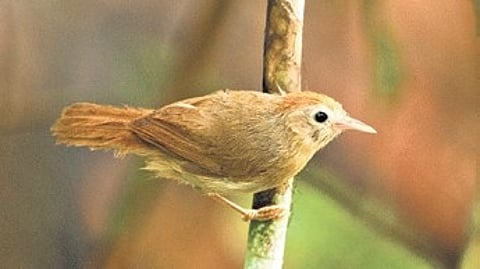

BHUBANESWAR: In a significant discovery for Odisha’s avifauna, presence of the elusive Rufous-fronted Babbler (Cyanoderma rufifrons) has been confirmed in Similipal Tiger Reserve (STR), providing the first evidence of a disjunct population of the bird species in Eastern Ghats.
The Rufous-fronted Babbler is a small insect-eating bird inhabiting the Eastern Himalayas, north-eastern India, Indochina and Sundaland. There had been no confirmed records of its existence in the Eastern Ghats until now.
A team of reserachers comprising Rajkishore Swain and Subhani Rath from department of Wildlife and Biodiversity Conservation at Maharaja Sriram Chandra Bhanj Deo University, Sourav Kumar Das from the department of Electrical Engineering at Institute of Technical Education and Research and Siddhanta Kumar Mohanta from Forest, Environment and Climate Change department compiled field observations over a decade from 2014 and 2025 to establish the presence in Similipal and adjoining forest landscapes. Most of the sightings were concentrated around Sitakund in STR while additional records came from Amdapani, Barehipani and Lulung road.
“The earliest documented sighting dates back to May 7, 2014, at Barehipani, while supporting observations from Mandasaru in Kandhamal district, Bastar in Chhattisgarh and parts of Andhra Pradesh further strengthen the possibility of a wider Eastern Ghats distribution,” the researchers said.
They said the birds were consistently found in dense bamboo thickets, climber-rich vegetation, riparian habitats and shaded forest understorey. They were observed foraging in pairs or small groups, feeding mainly on insects such as caterpillars and beetles while occasionally consuming berries.
The researchers have stated that the repeated sightings over more than a decade indicate the species is likely a resident of Similipal rather than a recent arrival. They suggest the bird may have escaped detection because of its secretive behaviour and its resemblance to closely-related babbler species.
“The discovery has important bio-geographic implications. It points to Similipal as a possible refuge for Indo-Malayan bird lineages in the Eastern Ghats,” the researchers said.
