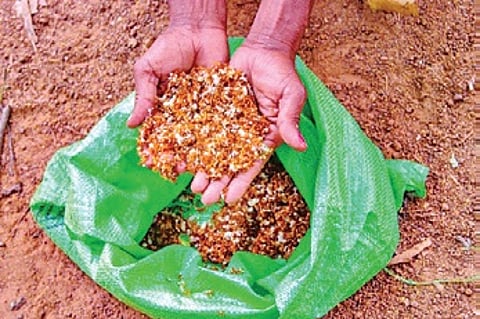

BHUBANESWAR: Amid growing efforts to link conservation with the lives of forest-fringe communities in the state, an innovative and rewarding model of livelihood is helping sustenance of nearly 50 particularly vulnerable tribal group (PVTG) families in Keonjhar, apart from ensuring the care of a vulnerable wildlife species.
By collecting red weaver ants, known locally as ‘Kai’ and selling them to Nandankanan Zoological Park in Bhubaneswar for its pangolins, the PVTG families from Bhuyan and Juanga tribes along with other forest dwelling communities in Keonjhar division have created a stable source of income for themselves and earned over Rs 12 lakh in a span of three years.
Forest officials said the initiative is emerging as a win-win situation, empowering local tribal communities and reinforcing the value of sustainable earning. Keonjhar DFO Dhamdhere Dhanraj Hanumant said these tribal families from forest areas of BJP and Telkoi ranges used to collect the red weaver ants from their colonies on Sal trees and sell them at meagre prices in the local market.
However, with Nandankanan Zoological Park in the state capital requiring regular supply of these ants for its pangolin breeding centre, the division launched an initiative to sell these ants to the zoo through formation of Van Suraksha Samitis (VSSs).
Within three years, from 2023-24 to 2025-26, around 47 tribal households have collected and sold over 3,436 kg of red weaver ants to the zoo, earning more than Rs 12.02 lakh. While about 840 kg of Kai was sent by the tribal households to the zoo in 2023-24, over 1.6 tonne (1,636 kg) was supplied in 2024-25.
In current fiscal of 2025-26, the PVTG families have already sold about 958 kg of Kai to Nandankanan.
By selling these ants to the zoo, the tribal households are generating an income of around Rs 350 per kg, while supporting the conservation of a threatened wildlife species, as ant is an essential food source for the pangolins.
“The innovative model, apart from enhancing pangolin conservation, has formalised a traditional practice securing a stable income for the local tribal families,” the DFO said. He added that the division has initiated several other initiatives to strengthen livelihood of local forest-dwelling communities.
Over 2,000 micro projects have been implemented through 200 VSSs in the division to reduce their dependence on forest for non-timber forest products (NTFPs) and enhance cooperation for effective wildlife management to reduce human-wildlife conflict, the DFO said.
