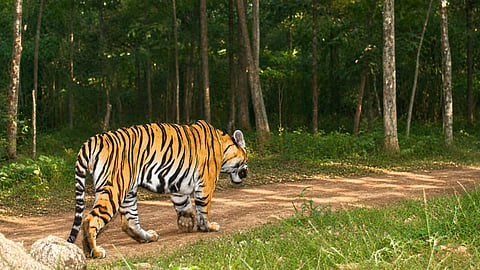

SAMBALPUR: Debrigarh Wildlife Sanctuary’s new striped visitor has been traced to Chhattisgarh’s Udanti-Sitanadi Tiger Reserve, where the male big cat was recorded for approximately six months in 2025.
Camera-trap images received from Chhattisgarh forest officials have confirmed its identity, providing the first scientific evidence of the tiger’s movement across the two landscapes. Further analysis of camera-trap records is underway to reconstruct the animal’s dispersal history.
Forest officials also indicated that the tiger may have originally dispersed from Maharashtra before reaching Chhattisgarh and subsequently Debrigarh. However, no photographic evidence is currently available to establish its earlier movement or confirm the route it followed.
The development follows an initiative by Debrigarh authorities to establish the source population and movement history of the adult male tiger, which was first detected in the sanctuary on November 9. The Hirakud Wildlife division had subsequently approached the National Tiger Conservation Authority (NTCA), seeking assistance in identifying the animal’s origin and obtaining historical records of its movement across tiger-bearing landscapes.
Official sources said camera-trap photographs shared by Chhattisgarh officials were subsequently matched with those of the tiger recorded in Udanti-Sitanadi reserve during 2025. The distinctive stripe patterns on the big cat’s body served as individual identifiers, confirming that the tiger recorded in both landscapes was the same animal.
Debrigarh authorities are now waiting for the NTCA to share any additional information available on the animal’s dispersal history to establish its earlier movement patterns and possible geographical origin. The findings could help determine whether it travelled through other forest landscapes before being recorded in Udanti-Sitanadi reserve.
For Debrigarh, the latest finding reinforces its significance as a potential dispersal landscape connecting the tiger-bearing forests of Central India with Odisha. The sanctuary offers nearly 350 sq km of relatively undisturbed core habitat following the relocation of all villages, besides a diverse prey base, extensive grasslands, forest cover and perennial water sources.
The movement history of the previous tiger recorded during 2022-24 was similarly established through stripe-pattern matching by the Wildlife Institute of India, which traced it to Kaghaznagar in Telangana in 2018 before the big cat moved into Odisha through the same Udanti-Sitanadi reserve.
While the possibility of a Maharashtra connection remains to be established, further analysis of historical records could offer a more comprehensive picture of the journey undertaken by the animal before reaching the sanctuary.
