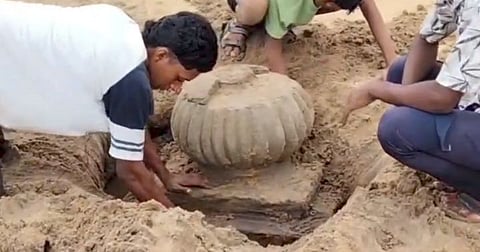

BERHAMPUR: A temple, locals believe to be dedicated to Goddess Gangadevi, has resurfaced at the sea beach near Podampeta in Ganjam, attracting large numbers of visitors.
The upper portion of the structure, including what is reportedly the Dadhinauti, the crowning element of a traditional temple, emerged from beneath the sand on August 29 after seawater receded along the coastline. This has generated widespread interest, with people flocking to the beach to witness the structure. Some visitors have also joined locals in removing sand from around the structure.
Locals believe the structure is the Gangadevi temple, which was built by villagers and is believed to have been swallowed by the sea in the late 1990s.
Academician Sabar Tarai, who recalled his grandfather’s account of the temple, said the shrine could not be formally consecrated before the settlement and the temple were engulfed by the sea.
However, the exact identity, age and historical significance of the structure have not yet been officially established. Sources said an archaeological survey, along with verification of government records, would be necessary to establish the structure’s history.
Incidentally, around two years ago, archaeological excavations were conducted at Palur, also known as Prayagi, around eight km from Rambha, by the Odisha Institute of Maritime and South East Asian Studies (OIMSEAS) under the department of Culture.
Sunil Patnaik, senior archaeologist and director (Excavation) of OIMSEAS said nearly 70 archaeological sites have also been documented in and around Palur, including areas near Podampeta. However, he said that the nature of the structure can only be established through extensive scientific excavation.
INTACH’s South Odisha convenor Sudhansu Pati also stated that the structure can be identified only after a detailed survey and excavation.
