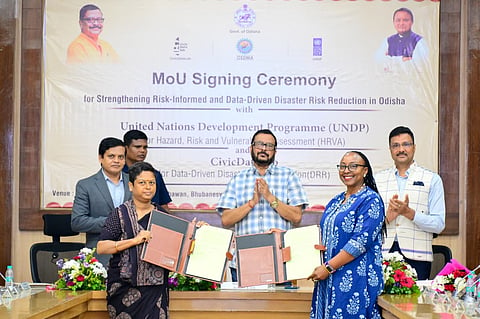

BHUBANESWAR: The Odisha State Disaster Management Authority (OSDMA) on Wednesday signed two MoUs with the United Nations Development Programme (UNDP) and CivicDataLab to integrate and adopt a more data-driven, scientific and technology-enabled framework for effectively tackling of disasters.
The partnerships are aimed at strengthening disaster risk assessment, preparedness and decision-making at the grassroots level, besides advancing the efforts towards building a disaster-resilient and safer state.
Revenue and Disaster Management minister Suresh Pujari stressed that disaster management should focus on anticipatory action, preparedness and risk assessment based on accurate and timely data.
“Data driven decision-making is critical for saving lives and protecting property while also enabling more effective and far-reaching development planning,” he said.
Under the partnership between OSDMA and UNDP, a comprehensive hazard, risk and vulnerability assessment (HRVA) will be undertaken across all 30 districts of Odisha. The digital HRVA system will provide a scientific and reliable evidence base for disaster mitigation, preparedness, climate resilience and long-term sustainable development planning across the state.
Meanwhile, through its Intelligent Data Solutions for Disaster Risk Reduction (IDS-DRR) platform, CivicDataLab will integrate data from multiple departments and provide real-time dashboards and analytical insights to OSDMA and all District Disaster Management Authorities, official sources said.
Data will be collected at the village level in 10 coastal districts vulnerable to cyclones and floods, while in the remaining 20 districts, the assessment will be undertaken at the GP level.
The data generated through the exercise will form the basis of a dynamic, GIS-enabled digital platform, which can be periodically updated in response to changing climate and risk patterns. The platform will support the preparation of district-level risk atlases and evidence-based policy decisions.
In the initial phase, the platform will focus on riverine floods, coastal flooding and heatwave-related risks, enabling more accurate assessment and forecasting and supporting faster, evidence-based decision-making. The system will bring data from different departments and sources, harmonise it and provide it in a standardised format. This will facilitate better coordination, analysis and informed action before, during and after disasters.
Pujari said these initiatives would serve as an important step towards achieving the state’s goal of ‘Zero Casualty’ and building a more resilient and climate-ready Odisha.
