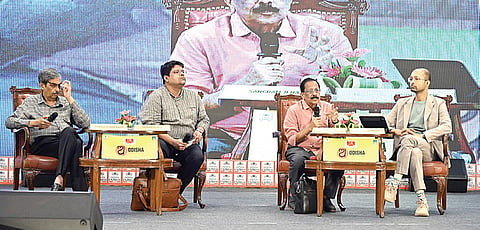

BHUBANESWAR: Literature lovers were offered a window into the life and legacy of Odia writer Jagannath Prasad (JP) Das on Saturday. Panellists at the 14th Odisha Literary Festival reflected on the trajectory of the IAS officer who resigned at the peak of his civil service career to devote himself to writing, art history and creative scholarship.
Opening the discussion at the session ‘In Memory of JP Das: Experiments with the Written Word’, translator and literary critic Prof Jatindra Kumar Nayak said JP was one of the last towering figures in a rich, traditional line of Odia men of letters, a lineage of versatile intellectuals, including Fakir Mohan Senapati, Gopinath Mohanty, Surendra Mohanty and Biswanath Kar.
This tradition of literary giants trying to enrich various aspects of a cultural work is getting impoverished with the rise of the universities which focus on only academics, Nayak said, highlighting how JP moved seamlessly across genres as a poet, novelist, playwright, translator, and art historian.
Discussing JP’s critically acclaimed historical novel ‘Desha Kala Patra’ (A Time Elsewhere), Nayak highlighted its radical departure from conventional historical fiction. Unlike traditional sagas which centre on heroic figures, the novel treats Time as the central protagonist across a 50-year transformation of Odia society. While its fragmented, kaleidoscopic structure initially disoriented readers and critics, the work eventually came to be recognised as a landmark achievement in modern Indian fiction.
Former vice-president of Odisha Sahitya Akademi, Sangram Jena, focused on JP’s poetic sensibility and his prolific work as a translator. As a translator, JP broke traditional molds by prioritising marginalised voices, particularly works by emerging women and Dalit writers. Though JP excelled in multiple genres, he fundamentally identified himself as a poet, said Jena, who is also a translator.
Associate professor of English at Delhi University, Animesh Mohapatra, shed light on JP’s playful, lesser-known side. Despite a no-nonsense public persona, Das had a deep rapport with children. He authored a substantial corpus of nonsense verse, limericks (Laghukabita), and educational primers, drawing inspiration from masters such as Edward Lear, Lewis Carroll, and Rabindranath Tagore to build a rich body of children’s literature in Odia.
Dispelling the myth of JP being a solitary, brooding character, the panellists remembered him as an intensely sociable and hospitable writer who harboured a lifelong curiosity about people.
Independent journalist and researcher Sampad Patnaik moderated the session.
