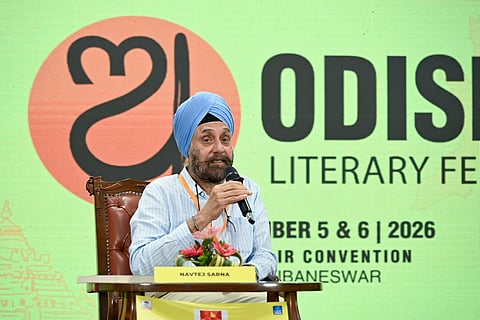

BHUBANESWAR: Author and former diplomat Navtej Sarna on Saturday reflected on India’s evolving national identity, forgotten freedom fighters and the complex human stories beneath familiar historical narratives at the opening day of two-day Odisha Literary Festival here.
In a session on The Art of Diplomacy: Writing Different World’ moderated by senior journalist Kaveree Bamzai, Sarna spoke about the making of the Indian national flag and how its transformation mirrored India’s journey from a movement resisting colonial rule to a modern nation state.
Recalling the Constituent Assembly debate of July 22, 1947, he said the decision to replace the charkha with the Ashoka Chakra was accompanied by considerable thought about the symbolism of the flag. “It changed from being a flag of resistance against power to a flag of a modern country,” Sarna said and explained that the Chakra represented not only Dharma but also progress.
He also traced the evolution of the flag’s colours, recalling the contribution of Pingali Venkayya and Mahatma Gandhi’s early ideas. The colours, he said, eventually moved away from communal associations to acquire meanings rooted in Indian philosophical traditions of sacrifice, purity, growth and detachment.
Sarna, whose historical novel ‘The Exile’ explored the tragic life of Maharaja Duleep Singh, said history often overlooks compelling figures who do not fit dominant narratives.
Discussing his other novel ‘Crimson Spring’, centred around the Jallianwala Bagh massacre, Sarna said he wanted to look beyond the massacre itself and capture the wider currents of history, including the Ghadar movement, returning soldiers of the first World War, Gandhi’s Satyagraha and the Gurdwara reform movement.
He said his research into Udham Singh revealed a far more enigmatic figure than popular accounts suggest. “He is an absolute fascinating. A great man and an internationalist,” Sarna said and described how Singh travelled under different names and identities before assassinating Michael O’Dwyer in London 21 years after Jallianwala Bagh.
Sarna also spoke about translating the ‘Zafarnama’, Guru Gobind Singh’s Persian letter to Aurangzeb and said that the work took him two years because of the complexities.
