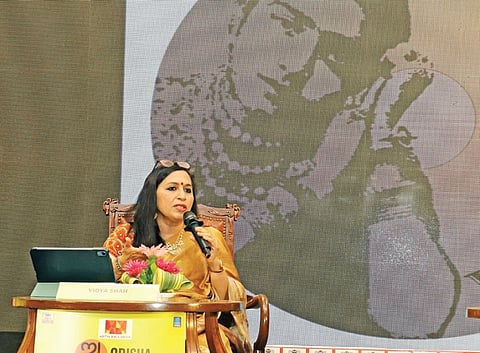

BHUBANESWAR: For singer and author Vidya Shah, blending vintage music with techno beats dwindles its emotional resonance.
Participating in the session ‘On The Record: Making Women’s Voices Heard’ at OLF here on Saturday, Shah said she does not prefer vintage music like Qawwali being remixed into upbeat dance tracks. Mixing classical music with techno beats changes how people feel the music. Listeners might focus more on the loud sound rather than on the classical piece, she said.
Shah said many listeners still prefer vintage music and remixing decades-old art form with modern club culture ruins the original intent of the classical piece. Tracks recorded in the early 20th century hold immense importance.
Reflecting on an incident from nearly 15 years ago, the musician said a spectator approached her after an concert and handed her two cassettes with a request to listen - insisting that within them lay true music. “For about a year, I did not open the cassettes. When I eventually opened them, I found a paper comprising a list of women singers whose names I had never heard before.”
Shah researched about the women and found out that they all were gramophone singers, some of them were famous while many others never came to spotlight. She realised that early gramophone singers, particularly trailblazing female artists like Gauhar Jaan, captured the hearts of listeners with their exceptionally melodious and powerful voices.
Shah then decided to highlight the journeys of talented women musicians of the early 20th century, who were gifted with bold and melodious voices, through her book Jalsa. “Jalsa is about the journeys of women performers in India from the salon to the studio. It attempts to give an insight into the contribution of women performers in Indian music,” she said.
The book narrates the experiences and growth of many gramophone singers, including the legendary Gauhar Jaan, for becoming the first Indian artiste to commercially record music on a 78 RPM record in 1902, she added.
Shah also noted that early gramophone recordings were dominated by women because male classical musicians rejected the technology, while female artistes eagerly embraced the new platform for fame and independence. The session was moderated by senior journalist Kaveree Bamzai.
