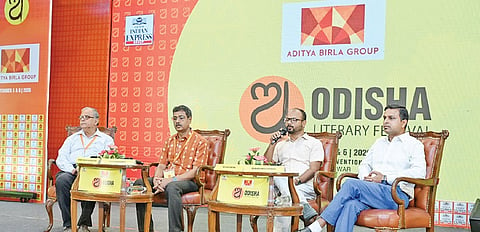

BHUBANESWAR: Key Odia publishers on Sunday said print and digital books would coexist in the future, but the publishing industry must adapt to changing reading habits and embrace new technologies to reach a wider audience.
Publisher of Grantha Mandira Manoj Kumar Mohapatra, editor of Paurusha and Aama Odisha Asit Mohanty, and founder of Pen in Books Subransu Panda were speaking at the session ‘The Future of Odia Publishing: Who Will Write, Who Will Read?’ on the second day of the Odisha Literary Festival. The session was moderated by writer Miyog Patra.
Mohapatra said that change was an essential part of evolution and expressed optimism about the future of Odia language and literature, which was recognised as a classical language. “We have come a long way from palm-leaf manuscripts to the digital era. Technology is developing and our language is progressing with it. I have great hope that our language will prosper further,” he said.
He said publishing, like writing and reading, was a form of tapasya (penance), adding that Grantha Mandira, which began in 1955, had completed 70 years.
Mohanty said Odia publishing had witnessed several changes over the years, from palm-leaf manuscripts to printed books and now digital formats. He said resistance to change was natural, but new forms were eventually accepted.
“The digital form of books should be welcomed by everyone. Even if we do not welcome it, we cannot stop it because it is the wind of change. If we do not accept it, we will fall behind,” Mohanty said. He also pointed to changing buying habits, saying readers were increasingly ordering books online instead of visiting publishing houses. He said that publishers needed to adapt to these changes to market books effectively.
Mohanty said another challenge was the limited circulation of books by young writers. Although many youngsters were writing good books, insufficient print runs often restricted their reach to a small circle of readers. He pointed to print-on-demand as one way of addressing the problem, allowing publishers to print even a single copy when required.
Panda, meanwhile, rejected the perception that young people were losing interest in books, saying youngsters were among the biggest readers and writers in Odia literature. “We usually say that the youth do not have any relationship with books, which is wrong. The real question is how interested publishing houses are in publishing them,” he said.
Panda urged publishing houses to create opportunities for young writers and help turn them into literary stars. He said the publishing industry needed to create a sense of excitement around books among young readers. “If a book gives you a fear of missing out like other things, then books will be sold in large numbers and more young readers can get the opportunity to write,” he added.
Mohanty stressed the need for younger writers to remain connected with the roots of Odia literature, saying readers continued to hold the pioneers of Odia literature in high regard.
