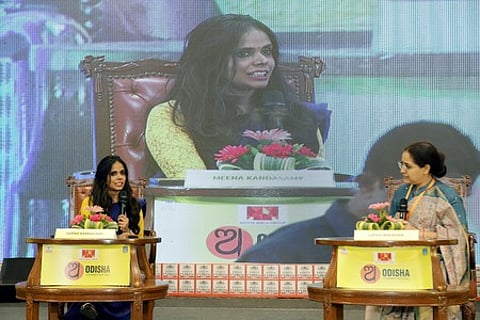

BHUBANESWAR: Female rage should be seen as a statement that challenges cultural expectations demanding women to remain quiet, said poet, author and translator Meena Kandasamy at the 14th edition of Odisha Literary Festival here on Sunday.
Participating in a compelling session titled ‘The Rage of Women: Lighting the Way Forward’ moderated by consultant and author Lipika Bhushan, Meena highlighted the necessity of rage in challenging the systemic silence of women.
“We live in a society where space for dialogue does not exist for women. What exists is the space for silence. And the only way to break this silence is not by making appeals of kindness and goodwill to the powerful. In a culture that wants to sweep the issues of women under the carpet, saying something provocative is necessary to be heard and initiate a dialogue. So rage should be seen as a vehicle of change,” she said.
Questioning the efforts to limit female rage only to the domestic sphere, the author said women have always been at the forefront of challenging state violence and authoritarian regimes. Meena cited the classical Tamil epic ‘Silappatikaram’ and highlighted the story of the protagonist Kannagi who stormed the palace and burned the city of Madurai after her husband was wrongfully executed by the king for stealing the queen’s anklet.
While traditionally portrayed merely as a good and chaste wife, Kannagi’s action represents a direct challenge to state power and injustice, she said.
At its most fundamental level, Meena said, feminism simply demands that women be treated as human and equal to men.
Challenging the belief that feminist ideology is a Western import in the 18th century, she argued that relying strictly on foreign frameworks fails to capture the realities of Indian society and overlooks rich indigenous traditions of female agency and autonomy articulated thousands of years ago.
She also drew parallels between caste discrimination and gender inequality and said both systems historically restricted access to knowledge, freedom and equal status. “Hinduism cannot survive while carrying the baggage of caste hierarchies and restrictions on women. The religion will self-implode if these divisions are not eliminated,” she added.
