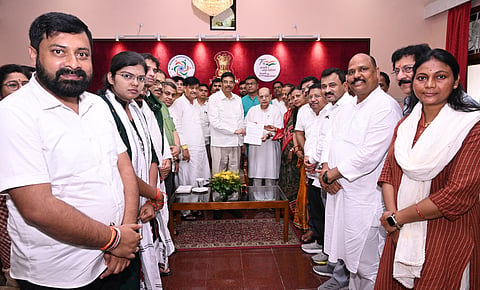

BHUBANESWAR: Intensifying its protest against the MMDR Amendment Act, 2026, the BJD on Wednesday staged a dharna in front of the Lok Bhavan demanding withdrawal of the legislation.
Party leaders, MLAs and workers joined the protest, stating that concern against the Act transcended political affiliations, as the matter directly impacted financial stability, developmental capacity and future interests of Odisha.
A delegation of the party submitted a memorandum addressed to President Droupadi Murmu through Governor Hari Babu Kambhampati, seeking her intervention to safeguard the financial interests of Odisha and protect its constitutional rights under the Act.
The memorandum stated that Article 244(1), read with the Fifth Schedule, provided a special constitutional framework for the administration of Scheduled Areas and Scheduled Tribes. The Governor has a special constitutional responsibility in relation to the administration of scheduled areas and is required to report to the President annually, or whenever so required, regarding their administration.
The Fifth Schedule also confers specific powers upon the Governor under Paragraph 5, including powers relating to the application of laws to Scheduled Areas and the making of regulations for the peace and good governance of such regions. These provisions form an important part of the constitutional framework within which laws and policies having implications for mineral-bearing areas must operate, it added.
The memorandum said the issue has assumed significance in view of the judgement delivered by the nine-Judge Constitution Bench of the Supreme Court on July 25 2024, wherein it recognised the power of state governments to impose taxes and levies on mines and mineral-bearing lands and also dealt with the recovery of such dues from the period beginning from April 1, 2005.
Following the judgement it was estimated that Odisha became entitled to receive more than `1 lakh crore towards arrears, apart from an additional annual revenue of approximately `12,000 crore.
This raises a legitimate question as to whether the earlier assessment of Odisha’s financial entitlement was incorrect or whether the present claim by the state government that there will be no loss requires reconsideration, the memorandum added.
