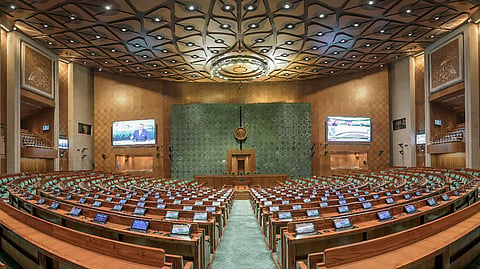

RAIPUR: As the Centre prepares for a special session of Parliament from April 16 to 18 to introduce a bill that reports suggest proposes increasing the number of Lok Sabha seats to 850, with one-third reserved for women, the Chhattisgarh Assembly is already reflecting comparatively high female political representation.
The upcoming session is expected to introduce a high-stakes bill to increase the number of Lok Sabha seats from the existing 543 to 850.
Draft legislation also proposes that a one-third reservation for women be implemented after a delimitation exercise.
This expansion aims to operationalise the 33 per cent women’s reservation brought through a Constitutional amendment introduced in the Lok Sabha on September 19, 2023, to reserve one-third of the total number of seats.
While the national debate intensifies over the "how" and "when" of the reservation, Chhattisgarh has emerged as an appreciable example of gender inclusivity in Indian politics.
The state currently has the highest proportion of women MLAs in the country, with women making up 21 per cent of its 90-member House.
The fact that 21 per cent of the House is now female despite a low nomination rate suggests that women candidates in Chhattisgarh have a remarkably high ‘win rate’ compared to their male counterparts.
The journey of the state’s legislative Assembly reflects a steady shift towards gender parity. In 2003, only five women were elected in the state’s first Assembly election.
In 2018, the number rose to 16 (including subsequent bypolls), and in the 2023 Assembly polls, a record 19 women were elected, 11 from the Congress and eight from the BJP.
During the 2023 elections, however, 14 political parties gave tickets to barely 13 per cent women.
Out of Chhattisgarh’s 11 Lok Sabha members, three are women, maintaining a representation of roughly 27 per cent.
This consistent upward trend in Chhattisgarh serves as a localised proof of concept for the Centre’s national ambitions.
The state has effectively bypassed the "readiness" argument, demonstrating that women candidates are not only contesting in higher numbers but are also winning in significant numbers.
