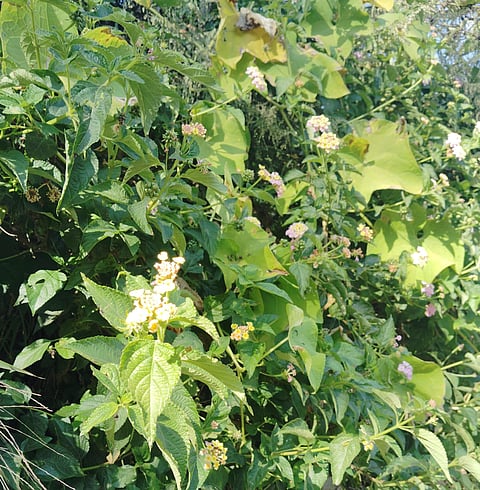

DEHRADUN: A colonial era import is staging a hostile takeover of the Central Himalayas. A new, alarming study by Professor Vishwambhar Prasad Sati and Surajit Banerjee of Mizoram University has identified Lantana camara, a shrub native to Latin America, as a primary existential threat to the region’s ecological and agricultural stability.
Once confined to low lying foothills, this aggressive invasive weed is rapidly scaling higher altitudes. Despite two and a half decades of concerted eradication efforts by the Uttarakhand Forest Department, the study reveals that the plant’s habitat has expanded by a staggering 93 per cent.
Published in the journal Environmental Monitoring and Assessment, the research underscores that the weed is no longer just a localised nuisance. It is now actively colonising the middle altitudes (900–2,000 metres) of the Siwalik and Himachal ranges.
The study warns that climate change is providing the perfect environment for Lantana to flourish. As minimum temperatures rise and winter snowfall becomes erratic, areas once protected by frost, such as parts of Chamoli, Uttarkashi, Almora, and Nainital, have become hospitable to the invader.
Speaking to TNIE, Professor Sati said, "A rise in the minimum temperature and increased variability of precipitation are the key climatic drivers providing an advantage to Lantana camara."
He added, "Native plants are sensitive to drought, and most grasses dry out in winter in the middle altitudes. Meanwhile, drought tolerant Lantana continues to thrive, effectively outcompeting native vegetation."
"The ecological damage is multifaceted. Lantana does not merely crowd out native species; it fundamentally alters the landscape, creating impenetrable, fire prone thickets, increasing the risk of forest fires by accumulating flammable biomass, and suppressing the growth of vital medicinal plants," highlighted Prof. Sati.
Expressing concern, Prof. Sati stated, "Furthermore, these dense thickets have become a haven for wildlife such as leopards, creating an additional risk by exacerbating human wildlife conflicts near forest fringes."
The researchers employed climate based modelling to predict the plant’s future spread. Under an extreme greenhouse gas emission scenario, the study projects an explosion in habitat coverage, up to a 173 per cent increase. By 2050, as much as 40 per cent of Uttarakhand could potentially be colonised by the weed.
Even under moderate emission scenarios, the spread remains significant. Coupled with human errors, such as deforestation and the improper disposal of weed waste along roadsides, the situation has reached a critical tipping point.
Professor Sati and Banerjee warn that without urgent, coordinated, and scientifically backed management strategies, the iconic Himalayan landscape risks a permanent transformation.
The battle against Lantana camara is no longer just about conservation; it is now a fight to preserve the ecological integrity and socioeconomic future of the mountain state.
