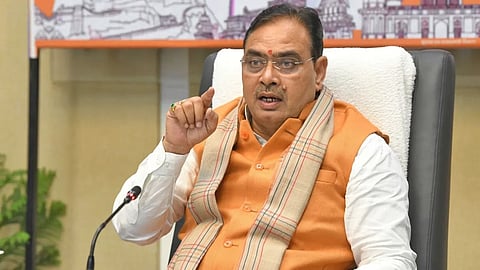

The BJP government in Rajasthan has reached the halfway point of its term. In December 2023, when the Congress lost the election, the BJP selected debutant MLA Bhajan Lal Sharma as chief minister.
The surprise choice has since been enjoying a relatively smooth tenure despite repeated attacks from the opposition. In a candid conversation with TNIE, asserted he has done his best to foster overall growth and development in the state. Excerpts:
How would you rate the performance of your team so far?
Our government resolved from the very beginning to ensure that the benefits of development reach the last person in society. We have undertaken extensive work across infrastructure, water, energy, roads, education, healthcare, agriculture, employment, women’s empowerment, and good governance. Today, Rajasthan is creating a new identity in investment, renewable energy, infrastructure, and public welfare initiatives.
During our tenure, over 48,000 kilometres of roads have been laid, piped drinking water has been provided to over 1.482 million rural families, energy production capacity has increased significantly, and millions of youth have been provided opportunities for employment and skill development.
Water scarcity is one of Rajasthan’s biggest challenges. What has your government done to address this critical issue?
We have signed MoUs with the governments of Madhya Pradesh and the Union for the Ram Jal Setu Link Project. Through this initiative, irrigation facilities will be provided to nearly 4 lakh hectares of land across 17 districts of eastern Rajasthan, while also meeting the drinking water needs of nearly 3 crore people.
Work on three feeder construction packages worth Rs 9,416.70 crore has already commenced and is proposed to be completed by 2028. Under the Yamuna Water Project and the plan to transform IGNP into a large reservoir under the Jal Jeevan Mission, work costing `208 crore has been completed.
To conserve groundwater, we launched the Karmabhoomi Se Mathrubhumi campaign, under which thousands of water conservation structures have been built. The construction of Amrit Sarovars has also led to noticeable improvement in groundwater levels at several locations.
What is your government’s strategy in the energy sector?
The state’s power generation capacity has increased by 9,264 MW and today Rajasthan is among the leading Indian states in terms of solar energy capacity.
To strengthen transmission infrastructure, new grid substations have been established, and investment proposals worth several lakh crore rupees in the energy sector have been accelerated. Work orders have been issued to establish 4,954 solar energy projects with a total capacity of 10,478 MW.
Arrangements to provide daytime electricity to farmers have been implemented in 26 districts, and significant relief has been provided on their electricity bills. Currently, Rajasthan ranks first in solar energy capacity and second in renewable energy capacity in the country.
What are your government’s major priorities and policies for roads and infrastructure development?
We have invested more than `32,000 crore in developing 48,296 kilometres of roads. DPR work is currently in progress for the construction of nine greenfield expressways with a total length of 2,750 kilometres. Thousands of villages have been connected with asphalt roads. Steps are being taken to strengthen the rural road network. Projects such as bridges, railway overbridges, Atal Pragati Path, and greenfield expressways are also being implemented at a rapid pace.
What about boosting investment and industrial development in Rajasthan?
Through the Rising Rajasthan Global Investment Summit 2024, investment agreements worth nearly `35 lakh crore have been signed, while work has already commenced on investment proposals worth approximately `9 lakh crore. Our government has simplified procedures for industry, strengthened infrastructure, and created a conducive, investor-friendly environment. To further promote investment in the state, 35 new policies have been introduced.
Agriculture and farming are traditional pillars of our economy. What steps has your government taken for farmers?
Under the Kisan Samman Nidhi, over `12,000 crore has been transferred to more than 7.6 million farmers. In addition, short-term interest-free crop loans worth over `53,000 crore have been made available to them.
Under the Pradhan Mantri Fasal Bima Yojana, insurance claims worth thousands of crores have been disbursed. The bonus on wheat procurement has also been increased, while farmers have been provided substantial support for electricity, irrigation, and agricultural infrastructure. Our effort is to turn agriculture into a profitable and sustainable sector.
Ensuring equality and dignity for women remains a major challenge. What is your government doing to promote women’s empowerment?
We have placed the social and economic empowerment of women at the centre of our development agenda. Under the Lado Protsahan Yojana, the financial assistance provided to girl children has been increased to `1.50 lakh. Under the Pradhan Mantri Matru Vandana Yojana, millions of women have benefited, and the scheme’s assistance amount has also been increased.
In addition, training has been provided to 2.1 million women, and efforts have been made to empower more than 1.6 million women as Lakhpati Didis. This is a comprehensive campaign to empower women to become self-reliant and economically empowered.
What are your plans to improve employment and education for the youth of Rajasthan?
They represent the state’s greatest strength. Our government has provided appointments to more than 1.25 lakh positions, while the recruitment process for over 1.35 lakh additional posts is currently underway. In addition, skill training has been provided to more than 3.46 lakh young people.
What have been your government’s top priorities in healthcare and social security?
Through the Mukhyamantri Ayushman Arogya Yojana and related health security programmes, better medical treatment facilities are being provided to the general public. In the social security area, the monthly old-age pension has been increased by `250. Through a transparent verification process under the Food Security Scheme, 8 million eligible beneficiaries have been included. Our objective is to ensure that no deserving person in the state is deprived of government support.
