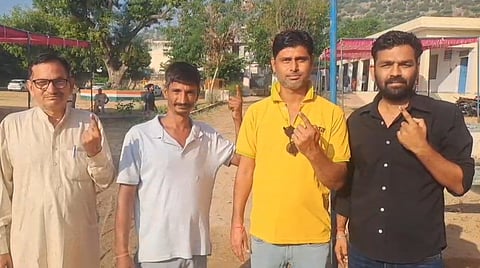

JAIPUR: The first phase of Rajasthan’s panchayat elections concluded on Thursday across 16 districts, with 6,926 candidates contesting 2,081 zila parishad and panchayat samiti seats. While public enthusiasm for polling was high in most rural areas, EVM malfunctions delayed voting at several booths.
During the voting throughout the day, technical glitches and malfunctions in Electronic Voting Machines (EVMs) disrupted and delayed voting across multiple polling booths.
The first phase of the election covered 16 Zila Parishads and 104 Panchayat Samitis, with over 85 lakh eligible voters. While polling generally proceeded comfortably, several specific regions experienced temporary halts as election officials had to replace the faulty machinery and shockingly, residents of a village in Pali boycotted polling over a change in their ward.
Polling was scheduled to end at 6 pm. The exact final turnout figures were yet to be declared but according to provisional estimates, over 63% votes were cast in these elections.
Deputy chief minister Premchand Bairwa cast his vote at booth number 92 in Srinivaspura village under Jaipur’s Maujmabad panchayat samiti. His wife Narayani Devi, son Chinmay Kumar and daughter Pooja accompanied him. He later posed at the selfie point. Medical and health minister Gajendra Singh Khinvsar voted in Khinvsar in Nagaur district.
The first phase covered an electorate of 85,07,306, including 43,86,768 men, 41,20,511 women and 27 transgender voters. A total of 9,886 polling stations were set up across 16 zila parishads and 104 panchayat samitis.
There were 1,693 candidates contesting 293 zila parishad seats and 5,233 candidates seeking election to 1,788 panchayat samiti seats.
While details of the final voter turnout are still unclear, the 3 pm update showed an average polling percentage of 48.85% across the 104 panchayat samitis. Calculated by averaging the panchayat samiti percentages within each district, Bikaner recorded the highest district average at 55.42%, followed by Phalodi at 53.78%, Barmer at 53.38% and Jhalawar at 53.08%. Pali recorded the lowest average at 40.29%.
In Jaipur’s Kalwad, an EVM fault interrupted polling for around 45 minutes in room number 5 of the Government Higher Secondary School. Voting resumed after officials installed a reserve machine.
Voters faced a longer wait at booth number 9 in Baru village under Phalodi’s Bap panchayat samiti. A machine malfunction at the beginning of polling caused a delay of about three hours. A replacement arrived around 10 am, allowing voting to resume.
Repeated EVM problems also disrupted polling at Bhilwadi School in Bhawani Mandi in Jhalawar. Voters complained that they had waited nearly an hour. The tehsildar visited the booth after the district collector was informed.
In Alwar, machines at booths 37 and 38 in Nyana gram panchayat under Govindgarh panchayat samiti were replaced following a beeping problem.
Despite the multiple EVM disruptions which caused long queues and voter inconvenience, the State Election Commission resolved the faults by replacing the malfunctioning units with backup EVMs. The efforts allowed polling to be successfully completed in all affected sectors.
