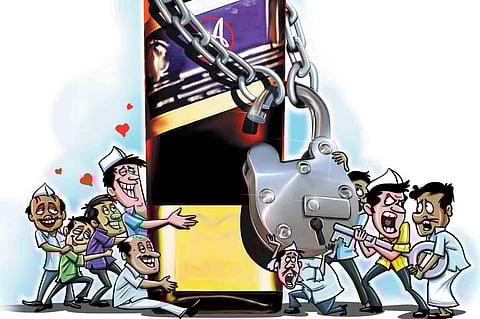

It happens with unerring regularity when parties begin positioning themselves ahead of a big election that could make or break political fortunes. Only this time, the voices are getting louder, and the usual suspects have some interesting company. You need not be a political pundit to guess that the idea is to expand their catchment area by drawing floating rural woman voters, suffer as many of them do at the hands of their drunkard husbands. But in a State as politically polarized as Tamil Nadu, it is not easy to wean away voters.
For starters, there has always been an undercurrent in favour of the dry law in the State. But if there was one top politician who has consistently demanded total prohibition, it was PMK founder S Ramadoss. For the rest, it was merely a ritual they had to occasionally revisit and pay lipservice. Of course, some social service organisations and public affected by the racket customers create at TASMAC shops and bars near their houses do make noises about prohibition from time to time, but their impact is at best local.
The issue gathered steam after MDMK chief Vaiko made it a plank and launched a padayatra Uvari in Tuticorin district to Madurai from December 12. Not to be outdone, Tamil Nadu Congress Committee president Gnanadesikan joined the fishing expedition, saying he would organise a copycat padayatra on the same issue.
A close look at the past reveals that the demand for prohibition has always been intertwined with politics. With the issue gaining traction, parties cannot quite ignore it.
Ahead of the previous Assembly elections, on December 22, 2008, the issue reached a crescendo when Ramadoss, VCK chief Thol Thirumavalavan and a host of leaders from voluntary and religious organisations called on the then chief minister M Karunanidhi and demanded implementation of total prohibition by closing down all TASMAC shops from Pongal day - January 14, 2009. Karunanidhi promised the delegation that he would take steps to implement prohibition in a phased manner, something he never intended to do.
But to keep the delegation happy, the next day, the wily Karunanidhi announced that no new TASMAC shops would be opened and the working hours of the existing outlets curtailed by an hour at night. Going a step further, the DMK general council adopted a resolution urging the government to move towards implementing total prohibition, again to appease the PMK.
During the course of his recent padayatra, Vaiko laid the responsibility for “the social, cultural and moral degradation in Tamil Nadu” at Karunanidhi’s doorstep. He claimed that the rot started after prohibition was lifted on July 20,1971 by Karunanidhi’s regime despite fervent pleas made by Rajaji. Vaiko blamed the rising crime graph in Tamil Nadu on the spurt in liquor consumption.
Chief Minister J Jayalalithaa, however, had a different take. Participating in the discussion on the demands for grants for the police department in the State Assembly a few months ago, she pointed out that drinking alone could be termed the cause for criminal activities and indicated that there were other contributory factors.
On September 7 last year, Minister for Prohibition and Excise R Viswanathan told the State Assembly that the State government was pursuing a middle path on prohibition policy considering the needs and aspirations of the people of the State. “The prime objective of the prohibition policy of the State is to guard the economically weaker sections from the evils of illicit liquor, which affects their health and ruins them socially and economically. With this objective in mind, the government has formulated a pragmatic policy in this issue,” he said.
“In a situation where the neighbouring States have relaxed their prohibition policies, it is impracticable to implement the policy of total prohibition successfully in Tamil Nadu alone. In the present context, it is not appropriate either to adopt a policy of total prohibition or to relax the existing prohibition policy as this will lead to loss revenue to the government. Hence, this government has been pursuing middle course,” he reasoned.
Months before the last Assembly elections, on May 25, 2010, the BJP’s Tamil Nadu unit demanded complete prohibition. Its State president Pon Radhakrishnan said a majority of men earning less than `100 go to the TASMAC shops to consume alcohol where they have to spend at least `70. He added that the graph of people consuming alcohol was on the rise, which would affect families monetarily.
And finally, weeks before the 2011 Assembly elections, on March 23, the VCK promised to strive for total prohibition in India.
Now that politicos are preparing for the 2014 Lok Sabha polls, the issue is back on the front burner. On October 17, 2012, in Coimbatore, around 600 activists, including 50 women, belonging to the Socialist Democratic Party of India (SDPI) were arrested when they attempted to stage a demonstration and lay siege to the District Collectorate, seeking dry law.
On July 25, 2012, Gandhians from various parts of the State participated in a one-day token fast in Palayamkottai, urging the implementation of prohibition. On the occasion, Gandhi Peravai president Kumari Ananthan recalled Mahatma Gandhi as placing liquor second on his list of bad practices after untouchability. Recalled that former chief minister Kamaraj was first arrested when he picketed against toddy shops n Tamil Nadu, Ananthan lamented that now liquor is being freely sold at Congress-ruled states as well.
It is a different matter that after people stage demonstrations demanding prohibition, some of them head direct to the nearest TASMAC outlet to quench their thirst. Say hic to that!
