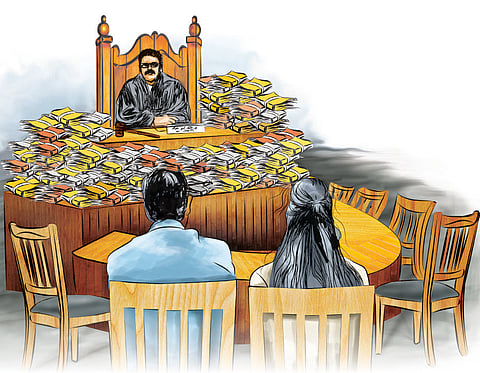

Set up 30 years ago to provide smoother solution to matrimonial disputes, family courts today have been reduced to an ‘advocate domain’ where feuding couples are taken on an emotionally, financially draining road to a bitter separation. Lawyers and litigants say adherence to criminal court-style arguing kills the idea of reconciliation in an ‘informal’ atmosphere which was envisaged in the Family Courts Act, reports J Santhosh
CHENNAI: When the setting up of family courts became a law in India 30 years ago, it was seen as a great mechanism for quicker and smoother settlement of family and matrimonial disputes. The Family Courts Act, passed on September 14, 1984, envisaged creation of an “informal” atmosphere where disputing family members can come, present their petitions with the judges and either reconcile or get amicably separated.
Also Read:
Thirty years down the line, popular experience suggests that family courts almost function like any other civil or criminal courts. Visiting them continues to be a painful experience for both men and women who are already undergoing a traumatic phase in their personal lives. Crowded court halls, huge pendency of cases and tedious legal process – all these problems typical to any other court are now plaguing family courts.
For starters, there is not even enough space in the family courts for the litigants to stand. “I have to jostle and stand in this crowd every time I come here to know the next date the hearing in my case is postponed to,” groans D Shymala (name changed on request), talking to Express in a family court in Chennai.
About 250 cases get listed every day in each of the four courts in the city. This means at any time in the day there has to be at least 100 litigants. Besides, the advocates and court staff have to be accommodated in a small court hall. “It takes at least two-three minutes for the litigants on hearing their names to jostle through the crowd and present themselves before the court. The fatigue on their faces for having waited so long is evident,” says a judicial officer who is at present a judge in one of the 19 family courts in the State.
He says the pendency is so huge that “calling work”, which is calling parties of each case and giving a date for next hearing alone takes up to 2 pm every day. “Only in the evenings, can we conduct the in camera proceedings. The calling work itself drains much of our energy. On an average, it takes at least three years for a couple to get divorce, if it is not by mutual consent,” says the judicial officer.
“Recently, a judge even fainted in the court hall as there were so many cases to be heard and she was conducting the proceedings until 8 pm every day. She was in charge of three courts that day due to vacancies,” says advocate Sudha Ramalingam.
She says the family courts have failed to achieve its objective of making the proceedings simpler. “The objective of the litigation was to make the entire proceeding simpler, friendlier and informal. But that has not been achieved. It is an emotional issue that the litigants are going through and they have to stand in such crowded places with no space even to breath,” she says.
Except Chennai, which has four family courts, none of the other courts in the State has either a crèche or a dining hall for the litigants, most of whom have to spend the whole day in court. Most of the litigants, who are single parents, are left with little option but to take their children along to the courts, which disturb the children mentally.
Recently, 13 new courts were opened in the State. But court sources say none of the newly inaugurated courts has an exclusive room for counselling. “My husband had applied for divorce, but he never appears for hearings. I have to meticulously follow the date of each hearing and come to the court. I fear that if I miss even one hearing, it will result in an ex-parte decree and the court will grant divorce. But, what is worse is that there is no proper place where I can sit with my son and have food. It is very difficult to access the canteen as it already crowded with advocates,” says R Sumathi, a litigant in a Chennai family court.