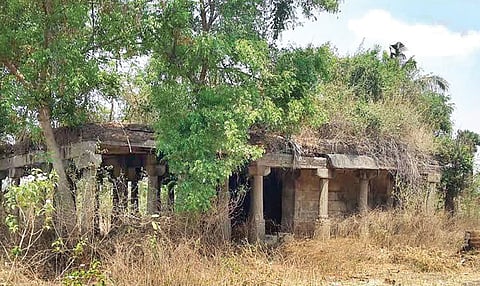

VELLORE: A century-old structure of archaeological significance is losing the battle against urbanisation and could be demolished soon.
The structure at Tuthipattu village, which now remains hidden among bushes on a ‘private land’, is crying for government patronage and protection.
Lara Thomas, a school student recounted how she first noticed the structure. “I saw this building while passing this area with my friends and we thought that it was a temple that required protection,” she said.
Former director of the Archeological Survey of India (ASI) P Venkatesan said that going by the centuries-old structure, it could have been used as a pilgrimage support facility. In those days, such structures were called ‘Chatram” where pilgrims could stay overnight.. He also feels that many such structures could have existed on this route but have had to face the brunt of urbanisation.
The location of the village along the ancient pilgrimage route linking Tiruvannamalai and Tirupathi makes Venkatesan believe that the structure catered to pilgrims enroute to the Tirumala temple. He said that 10 more dilapidated structures found in between Tiruvannamalai and Kalasapakkam corroborated his theory that there existed a pilgrim route passing through Thuthipattu in those days. Another route linking Vandavasi and Tirupathi via Kancheepuram also housed many such ‘Chatrams’ in ruins, he added.
Venkatesan, who is presently compiling a research publication on pilgrimage routes of ancient Tamil Nadu, said that in those days pilgrimage was considered the ultimate path to renunciation and every family undertook the ordeal of travelling long distances with religious fervour. Recognising the social importance of these pilgrimages, kings allocated funds to maintain these ‘Chatrams.’ Interestingly, his studies pointed out that many of the ancient pilgrim routes continued to serve as major roads even now linking many pilgrim centres.
He also feels that the State government and the ASI should take responsibility for such structures and protect them as monuments.
