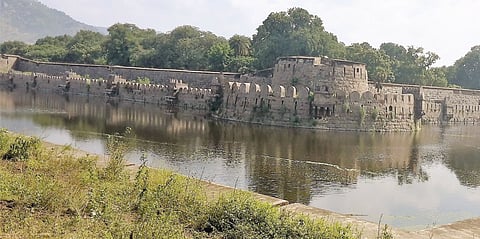

VELLORE: The heavy rains have highlighted the increasingly deteriorating state of the historic moat around Vellore Fort.
While Vellore and its suburbs received copious rains, it has further damaged the moat which is the biggest and the oldest rainwater harvesting system in the Fort city.
Vellore citizens have appealed to the state and central government to renovate the moat which will help raise groundwater levels as well as help preserve the historical monument.
Rotarian Shanmugam who launched the ‘Save The Moat Campaign’ recently recalled that around 30 years back when Vellore received torrential rains, he had seen water level rising high in the moat and water from the ground below the sanctum sanctorum of the Jalakanteeswar temple submerged the lingam. The temple, constructed some six hundred years ago by the architects of the time, built a system that kept the water level both in the sanctum sanctorum and the moat in balance, to justify the name - Jalakanteeswar (meaning water submerged lingam), he pointed out. He said he had witnessed the lingam submerged in water once and that he would like to make this a permanent reality.
The Fort’s known for its ancient military architecture and built in an area of 136 acres has a prominent moat that stores water to a depth of 16 feet.
Historically this Fort has witnessed several dynasties and the moat protected the Fort from attack. Ancient Tamil literature refers to the moat being full of fresh water and the home to thousands of crocodiles as an additional security cover. The moat had a drawbridge to provide temporary connectivity to the Fort that was removed by the British in the 1800s when they had to break into the Fort to quell the Sepoy Revolt.
Shanmugam said that at one time there existed an excellent water-inflow system that replenished the moat. There used to be special canals that brought rain water from the adjoining Otteri and Saduperi lakes that would replenish a series of ponds on the way before entering the moat from the north-west side. After replenishing the moat it would exit from the sluice at the south-west side of the Fort to join another canal draining into the Palar River.
Col Nicholson, the administrator of Vellore in the early 1900s, had renovated the canal system not only to benefit the moat but also to benefit the water-needs of Vellore town. With neglect and no upkeep, the canals and ponds have disappeared and there is no inflow or outflow of water from the moat, he added.
“Today the government is spending large sums of money to construct rain-water systems. This moat has been gifted to the people of Vellore by the kings and we do not know how to preserve it,” lamented social activist R Chandrasekaran. While the water level in some parts of the moat has risen two to three feet thanks to the rainwater percolation in and around the Fort, the other parts remain dry. The plan to desilt the moat two years back drawn up by the Archeological Survey of India, has not been implemented, so far, he added.
