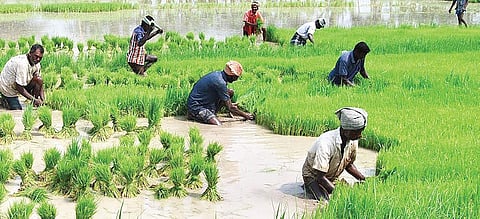

Vaan poyyinum thaan poyya, malaiththalai iya kadar kaviri (Even if the rain failed, the Cauvery will not), they once said. On some days, she was the gentle mother who cradled Lord Shiva at the Saranatha Perumal Temple near Kumbakonam, and on some others, she ran with such unsparing might that Karikala Cholan had to raise floodgates to tame her.

Nevertheless, as anyone in the Cauvery delta would tell you, Ponni, as the Cauvery is sometimes called, for her power to turn everything in her way to gold, never failed.
But in the 60 years that Mannargudi Ranganathan had been a farmer, this was a year like none other with both the skies and river having failed them. With the limited storage in the Mettur dam, it now also seems likely that the northeast monsoon would play truant, hitting them where it hurts the most.
“There are some things that we have grown accustomed to, like the cyclone in the Tamil month of Aippasi and the eventual flooding,” said the geologist turned leader of the Tamil Nadu Cauvery Delta Farmers Welfare Association.
However, they said they had always braced themselves for the cyclone that had been occurring since 1952, which was usually at its worst in November and would last until December 22 by making sure their crops were fairly ripe by then, enough to withstand the wind and water. But this year’s plight had been least expected. They have been forced to forego the Kuruvai since the last five years, but they are staring at a strong possibility of losing Samba, their only crop of the year, this time.
“Ideally, Samba should have begun on August 1. This time, it was by October end,” said Cauvery A Dhanabalan, Cauvery Farmers Protection Association.
The dam was opened on September 20 this year, with water reaching the tail-end only on October 5, he added. Though the sluices have not been opened on the customary date of June 12 for the last few years, it was opened on August 9 last year, allowing the farmers five months for the long duration (150 days) Samba crop before the sluices close on January 28.
The delta is primarily dependent on the water from the dam, according to Ranganathan. From June 10 to September 30, 135 tmc out of the 192 tmc should be given and the northeast monsoon is required only for the remaining 55 tmc.
Divided by the delay
As a consequence of the delay in both the northeast monsoon and the release from the dam, the farming system in the delta has gone for a toss, dividing the farmers geographically, as those who are praying for rain and those against it.
Those in areas blessed with groundwater — mostly in 70,000 hectares in old delta — have gone ahead with the transplantation after raising the nursery. While the advantages of the transplantation method of paddy are many, copious water supply is essential and hence is mostly carried out in areas where ground water is available.
Muthu of Mariamman Kovil in Thanjavur, for instance, raises three crops a year, thanks to the borewell water available at 150 ft for his 15 acre paddy field. If there is a good spell of rain anytime soon, Muthu’s field would be waterlogged, killing young seedlings.
While there are drainage canals to avoid water from stagnating, the canals in many fields have not been desilted in several months, rendering them useless.
Some like Bose of Kalakudi in Thanjavur scrape together their savings to desilt the canals themselves. “I have to spend Rs 5,000 to Rs 6,000 for it,” said the 58-year-old farmer, who has spent his entire life farming, starting off with a two-acre field that he purchased a few years after coming from Madurai as a farmhand to Thanjavur and later managing to expand it to 10 acres.
However, as Ranganathan explains, the availability of ground water in the entire delta is only a maximum of 38 tmc, with which both irrigation and drinking water needs have to be met, forcing others in the delta to turn to direct sowing.
Hopeful after the showers in September, farmers in Thanjavur opted for direct sowing covering 25,000 hectares against a total of 60,000 hectares that came under Samba cultivation as on October. All of them are now looking skyward, looking for some relief.
Even so, Ganesan (55), who has eight acres of paddy field in Orthanadu, said it would take a lot more than mounting debts and the lack of rain to stop him from far ming. “If my crops fail this season, I will borrow some more money and try again next season.” Though his son does not stop asking him to give it all up and let him settle the debts, Ganesan said, “This is all I know. This is what I will do until I die.”
History of the delta The Cauvery delta, an equilateral triangle of 16 lakh acres, has the longest history of paddy monoculture, said Mannargudi Ranganathan.
Two thirds of the Cauvery basin has plastic clay soil, making it ideal for paddy because of its capacity to retain moisture.
The Vennar basin, however, entirely has plastic clay soil — the main reason why farmers in those areas find it impossible to shift to anything other than paddy. The new delta was formed after the Mettur dam was built in 1934. It includes parts of Thanjavur, Tiruvarur, Nagapattinam and Pudukkottai.
Alagesan of Adichapuram and Rajesh Kanna of Keelathirupanthuruthi lived in places that are 60 km apart. But they had much in common. Both had debts, two acres of land that they did not own and two daughters and a son each. Both died on the same day also.
Two days after Rajesh’s death, the family was clueless about what future holds for them. Twelve-year-old Ramani was at the entrance drawing something. Her brother Rajkiran, his head shaved, stood silently by his youngest sister, 10-year-old Yazhini, as his mother wailed. It had been 21 days since Rajesh (42) had directly sowed the seeds in his two acre field that he had leased for 12 bags/acre. With the mild showers, the area received a few days ago, some of his seeds had grown to see the light of day. But when he visited his field early on November 5, his crops had already withered. It was the second time this season that direct sowing failed him.
“We took him to bundle paddy shoots in another nursery on a daily wage basis to take his mind off this,” said his neighbour Rammaiah. “He kept talking about how he would not be able to repay the loans and after just four or five bundles, he complained of a chest pain and we took him home where he died,” Rammaiah added.
Alagesan’s house was built on poromboke land. His elder daughter Elakkiya’s drawing adorns the entrance. Elakkiya had paid Rs 3,675 as fees to study BA History in a Government Arts College in Mannargudi.
“I have to pay the balance of Rs 2,000 and have four books to buy,” she said, flanked by her brother Akilavanan of Class IX and sister Yogapriya who is in Class XI. Alagesan was found dead in the field he had leased for Rs 18,000.
Sons of Alagesan and Rajesh also have something in common — both have not decided what they would grow up to be. “A farmer?” I ask and they shake their heads feverishly before the word fully escapes the mouth and you know not to ask again.
In 1998, Dhanaba’s father applied for free agriculture service connection. Today, 18 years later, a lot have changed. Dhanabal, who has a four acre farm in Tiruvarur, lost his father, but was blessed with two sons. But the free power supply that his father applied for still evades him.
For his application for connection to be accepted, TANGEDCO requires the sketch of the location of the bore that is issued by the Village Administrative Officer along with the ownership certificates, sale deed and the chitta. Once, the application is accepted, the service is awarded on a seniority basis.
Farmers have to install the borewells before applying for the free connection. However, even if it comes when it does, said farmers like Ahmed who has been lucky to avail the free connection in only 11 years, it would still burn a hole in the pockets to reinstall the borewell that is easily 15 years old when the supply finally arrived, setting them back by Rs 20,000 to Rs 25,000.
“The static water level in the borewell would have gone down by that time and often submersible pumps need overhauling or the borewell needs to be dug elsewhere for a considerable yield,” said Varadarajan, a farmer in Mannargudi.
With the delay in monsoon and sometimes even otherwise, almost 17 per cent of the farming in the delta rely on borewells with the old delta region said to be having maximum borewells.
But farmers can opt for borewells if they have the money or the luck of being geographically positioned at an advantage for getting water at least at a decent depth. Those that have neither, turn to rented diesel engine pumping sets.
Kalaichelvan Thangavel of Keelathirupanthuruthi said that he rents the diesel engine for Rs 150 an hour for almost 10-12 hours a day. That apart, he also has to bear the diesel expenses that would work out to around Rs 170 an hour for around 1.5 litres of fuel, which is required to run the engine for an hour.
This, or the farmers borrow water from their rich counterparts in the neighbourhood who have borewells. However, some farmers like Ganesan, owner of an eight acre farm in Orathanadu, said that the power supply was erratic and hence it was difficult for farmers to lend water.
According to Kathir (name changed), the sanctioned connection is originally given for a load of 5 HP, but motors with a capacity of 7.5 HP to 10 HP were required for irrigation during times like these.
The difference between Thanjavur, Tiruvarur and Nagapattinam is the green of the fields. While most parts of Thanjavur and some parts of Tiruvarur have managed to retain the colour of the fields, the fields go from yellow to brown as one passes through Thituthuraipoondi to Nagapattinam.
Nagapattinam, already last in line for the Mettur water, is perhaps the worst affected with the delay of monsoons adding to their woes, apart from the usual waterlogging that Nagapattinam is known for.
“Now that we have just sowed our crops, if there is an 80 mm shower, our crops will be ruined,” said M Seran, a farmer who belongs to Nagapattinam.
Their crops must ideally be 60 days old and should have grown to a height of 2 ft to withstand the effects of waterlogging.
According to Seran, 57 per cent of Nagapattinam was affected by salinity. If at all groundwater is available in these areas, the pros are sometimes outweighed by the cons, farmers said.
For instance, additional measures to counter salinity is required, resulting in increased production costs.
Change in pH levels do not immediately affect the soil, but it leads to the deterioration of soil quality over a period of time. Ideally, the pH levels for irrigation water is between 6.5 and 8.4. When the pH increases beyond this range, sulphur or other acidic substances are often applied to counter the effects.
However, for small and marginal farmers, it is easier said than done.
“After every time that we irrigate, we will have to apply copper sulphate because of the salinity here. One bag costs Rs 170 and we need two bags per acre,” says a small farmer in Kottur, Nagapattinam.
Even after this is done, their yield is significantly lower than that in other delta regions such as Thanjavur, claim farmers in the district.
“We only get around 20 bags per acre these days,” said Seran.
The salinity phenomenon has crept into parts of Tiruvarur too, said farmers. When a farmer goes down, so do the farmhands. According to a memorandum presented by the Tamilnadu Cauvery Delta Farmers Welfare Association and other associations to the technical committee headed by G S Jha that had visited the delta recently, landless labourers have lost mandays, especially in Nagapattinam.
With farmers foregoing the Kuruvai crop and the subsequent reduction in acreage of over 3.5 lakh annually and with unavailability of water during the most productive part of the crop season, landless labourers lose 70 out of 150 mandays in a crop year.
Irrigation water problems aside, residents of Raghunathapuram, 60 km from Nagapattinam, said that drinking water supply in itself was erratic in the region in stark contrast to Thanjavur where drinking water crisis is almost unheard of.
“If water comes today, we don’t really know when the water will be supplied next — it may be two or three days sometimes,” said Alamelu, a housewife in Raghunathapuram.
After her husband died 23 years ago, Indrani would go out pretending to inspect her five acre field, although there was nothing growing on it except weeds. In reality, she was checking what was going on at her neighbour’s farm.
“That’s how I learnt how to farm,” said the now 62-year-old from Kalakkudi in Thanjavur.
When her husband was alive, Indrani could easily count the number of times she had set foot on the field. It was mostly to fetch her husband for lunch or when he had visitors.
“I began to watch the neighbouring fields carefully. When they brought tractors over or when they irrigate their fields. I decided I should do the same,” she said.
She would farm because she had no choice. Her sons were still in school and she could not think of anything else to do.
One acre of a paddy field, in most places in Thanjavur, would yield around 30-32 bags in a good year, helping them make a total of around Rs 15,000 to Rs 20,000, more often than not, allowing them only to break even. “There is no profit here and no loss. It has been that way for many years,” said the mother of two sons.
Now, even after her sons have grown up, she is the only one taking care of the field. Her younger son works at a private firm and her oldest has left for a Gulf country leaving his wife and child with his mother.
The men of the house migrating, especially to the Gulf, was a common phenomenon in these areas.
Some women like 25-year-old Anu does not cultivate because she has to; she farms because it brings back memories of her father, because farming has given their family everything that they have today and it liberates her in a way that she has not yet found how to explain.
Everyone in her small village knows this papa, who single handedly takes care of her father’s field, but they don’t know her name. Tell her this and she laughs.
When her father Gunasekaran died 10 years ago, Anu was just out of school. The villagers tried to persuade her mother into selling off the 100 acre land at a throw-away price.
“Now who will take care of such a large field? Better sell it off now before it becomes a burden,” they would tell her mother, who decided to keep the land. A decade later, Anu makes at least 2 lakh of profit from the paddy field.