
NAGAPATTINAM: Owing to the bitter lessons learnt last year, the period that saw an acute shortage for black gram in open market, the black gram cultivation has been taken up by the farmers extensively across the tail-end delta. Though the overall demand for black gram encourages farmers here to grow the cash crops, farmers said that the black gram cultivated through organic methods has been receiving rousing response from the urban populace of the State than their inorganic counterparts. Despite the hefty prices fixed for organic black gram, farmers here said that the demands for such consumer friendly black gram are such that they could not address the towering demands coming up from neighbouring States as majority of the organic produce is sufficient enough only to address the surging demands within the State.
According to district agriculture department, it is said that the black gram and green gram cultivation are extensively taken up across 85,500 hectares majority being in Mayiladuthurai, Sirkazhi, and Kuthalam localities. With the conclusion of paddy harvest, as farmers by and large would opt for black gram cultivation to strengthen the soil nutrients as black grams are known for imparting nitrogen content to soil, comparing to the previous year, additionally about 20 per cent of acreage were covered under gram cultivation. Since the production of black gram has been facing a downfall leading to towering demands, the organic farmers here exploiting the heavy demands have constituted an organic pest repellent cum fertilizer for prevent pest attack and also to enhance the black gram yield for matching the demands. The organic manure was said to be formulated from the leaves of as many as seven trees and plant varieties including Vembu (Melia dubia), Nochi (Vitex trifolia), Adathoda (Adathoda vascia), Erukkanchedi (Calotropis gigantea), Papaya, and Kattamani (Jatropha gossypiifolia).
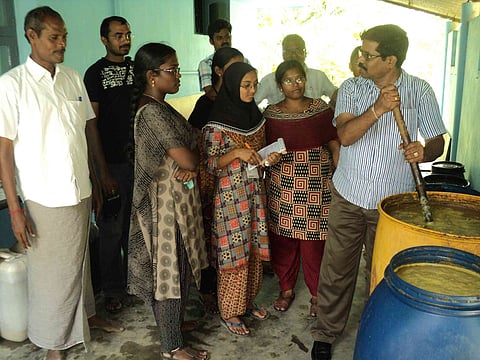
Speaking to Express, Nel R Jayaraman, organic farming trainer, “Leaves of six plants and tress should be mashed traditionally by using stone rollers. Then the green paste should be mixed with five litres of cow urine (does the role of urea) and kept sealed for a couple of weeks. Later on 300 ml of the organic mixture should be mixed per 10 litre of water for spraying over the black gram fields.” Besides eliminating the pest infection from affecting the black gram cultivation at various stages, the farmers here cultivated black gram under organic method by using the organic pest repellent said that total yield last year had seen a substantial surge by about 25 per cent than usual cultivation carried out with inorganic fertilizers. The medicinal values of the plants used for formulating the organic pest repellent was hailed for boosting the yield in black gram. “An acre of black gram cultivated with inorganic fertilizers can fetch about 490 kg of black gram produce as yield. Whereas, through organic cultivation such as using organic pest repellent and panchakavya, an acre of black gram field can post 600 kg as yield. As much as 9 lakh acres have undergone black gram cultivation through organic mode across the delta districts.” Nel Jayaraman added.
The organic farmers here said that owing to heavy awareness among the urban populace in Coimbatore, Chennai, and Madurai cities, demands for organically grown black gram was said to have soared exponentially in recent times. As a kilogram of inorganic black gram fetches `120, the organically grown black gram has been fetching `175 per kilogram. Farmers despite the heavy prices for organic black gram produce reasoned that batter made of organic black gram was found more dense than the batter made with inorganic black gram. Farmers hailed it as reason for the organic black gram to receive great response among the public in metro cities.