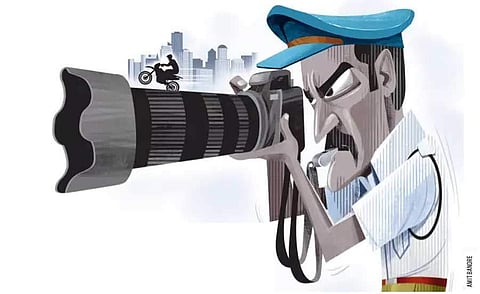

COIMBATORE: The delay in linking the traffic regulation mechanism's two halves -- ANPR camera surveillance and One nation-One challan system -- has birthed a new digital nightmare. Police personnel are now having to manually take pictures of visible traffic violations and upload them to the server to generate e-Challans against the offences. This, because the One nation-One challan system cannot use the output of the ANPR camera surveillance until the two systems are linked to make the entire process completely automated.
The use of the nationwide challan system is steadily being made mandatory. It makes the second half of the regulation process seamless -- it provides all details, including past offences, against any registration number, generates a challan, sends it to the offender and allows for payment against the challan too. However, practical concern with using the system is that it does not take the output generated by the ANPR camera surveillance that handles the first half of the process.
The output-input disconnect
The ANPR system has two components working together -- a smart camera that captures the registration plate of a vehicle and a CCTV camera attached to it that photographs the offence committed. Information from the two is combined to produce a challan. This is then either manually delivered to the offender. With the use of One nation-One challan system being insisted upon, it is this compiled information that has to be fed into the nationwide database. Turns out, it is not as simple as it sounds. Not only is it a complicated task that involves two separate platforms, but it also requires manpower that the Traffic police cannot spare.
Manual work for an 'automated' system
That is why Traffic police personnel are now having to manually photograph visible offences at key points in the city. All the stations have been provided with an amateur camera, says a senior police official. Given that the ANPR system is only available at 13 (five on Avinashi Road and eight in City West subdivision) traffic junctions so far, this allows the police to cover more areas and register more offences. These pictures are then uploaded into the One nation-One challan system, which would then carry out the rest of the process of challan generation and fine collection.
With the new process put in place this week, there are already as many as 3,000 e-Challans being generated per day, says Commissioner of Police Sumit Sharan.
The way out
The purpose-defeating manual work involved in a process that is supposed to be automated is the result of the delay in linking two disparate systems. The City Police had recently sent a recommendation to the National Informatics Centre, seeking permission to merge the ANPR camera surveillance with the One nation-One challan system. Such a merger would allow for complete automation of the traffic regulation process. The ANPR system, though it generated challans automatically, required police personnel to personally hand over them to offenders and did not have provisions for online payment of the fine.
