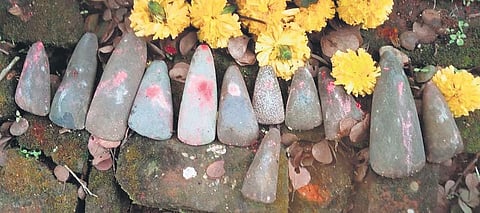

TIRUPATTUR: A group of cultural and archaeological researchers have stumbled upon stone tools dating back to 3500 BC, and stone inscriptions that throw light on Chola and Vijayanagara periods, atop Jawadhu Hills in Tirupattur district.
Led by professor G Mohan Gandhi, serving with the Sacred Heart College, Tirupattur, the researchers recently held an expedition atop the hills. They found 12 stone tools kept in a Hanuman temple at Chittoor in Pudurnadu. Archaeologists say that the stone tools date back to the Neolithic period.

“The stone tools we found atop Jawadhu Hills belong to the late phase of the Neolithic culture and date back to about 3500 BC,” says P Venkatesan, retired director of Archaeological Survey of India (ASI). He was also part of the group which held the expedition on the hills.
“The stone tools were sharpened and polished hand axes. Some are in good condition while a few others are damaged and broken,” Venkatesan states.The local tribesmen found the tools in the slopes of the valley near a water source while tilling land. They collected and enshrined them in the temple. “The tribes revere the stone tools as objects of worship,” the archaeologist notes.
Apart from the stone tools, the team found four stone inscriptions in the premises of the Lord Shiva temple at Molalai hamlet atop the hills belonging to Chola and Vijayanagara periods. One of them, dating back to 16th century AD, mentions about Vijayanagara king Kambannan. According to the inscriptions, he was also known as Mahamandeswaran and Kambanna Udaiyar.
Mohan Gandhi states that the main feature of the inscriptions is the reference to Jawadhu Hills as ‘Niravimalai’. “One of the inscriptions mentions the hills as Niravimalai. The term Niravimalai finds a mention in Malaipadukatam, part of Pathupattu (Ten Idylls), an anthology of 10 poems in Sangam era,” he points out.