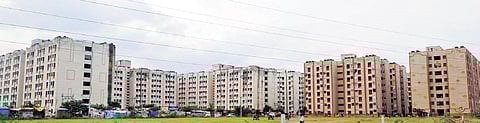

CHENNAI: Should we construct high-rise buildings across the state to provide housing units for economically weaker sections? A new draft housing policy prepared by the Tamil Nadu planning department says it may not be a good idea.
Quoting various studies conducted on Mumbai’s slum rehabilitation models, the draft policy says such accommodations will have a negative impact on low-income households. The policy states that such tall structures will not have livelihood spaces for small-scale vending, selling home-based products, or rearing livestock. “High-rise buildings need larger space between buildings, and this would reduce the number of housing units that can be accommodated in a specific plot,” the draft said.
Such tall projects for low-income groups often sidestep open space rules resulting in the creation of vertical slums. “Mumbai’s experience shows that going vertical would mean suspending planning norms on distance, light and ventilation, with a serious impact on public health,” the report said.
Quoting the study ‘Association between architectural parameters and burden of tuberculosis in three resettlement colonies in Mumbai’, the draft said residents of high-rise buildings for the poor are prone to a higher incidence of tuberculosis.
Due to higher operational and maintenance costs, the report says high-rise structures are not always sustainable for low-income households. High-density, low-rise neighbourhoods can be a better option. The report says the number of families that can be accommodated on small plots with more open space as compared to ground-plus-three tenements is the same. “Small plots also give the option to build a second floor and possible income-generating spaces,” it said.
“Site and service-based incremental housing allow personalisation of housing stock. An international study also showed that high-density, low-rise structures are environmentally more sustainable,” the study said. Sources said the policy is being drafted to address the needs of sections in rural areas such as fishermen and weavers.