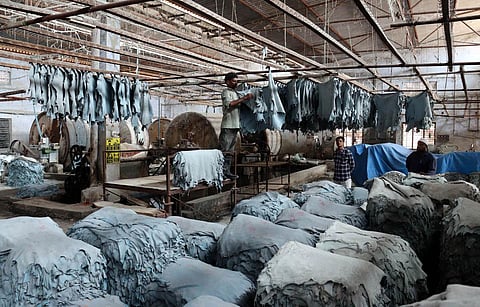

CHENNAI: In tune with the changing world, the leather industry has shifted its focus towards adopting green practices, including reducing the usage of water and chemicals and waste to capture the lucrative market.
Though the industry has addressed the liquid waste problem with zero liquid discharge (ZLD), much needs to be done towards solid-waste management, said the Director of the Central Leather Research Institute (CLRI), Dr KJ Sriram, told TNIE.
“Initiatives like recycling and making biodegradable products, and traceability will develop in the years to come,” he said. In traditional tanneries, for every tonne of skin processed, almost 700 kilogrammes are wasted.
CLRI is conducting research on recycling different kinds of waste that includes making synthetic tanning material out of shaving waste, converting flesh waste into poultry feed, collagen to develop bio-materials, and hair waste into pharma-grade gelatine. The institute is also working on powering batteries using waste on an experimental basis. Many of these researches are in the nascent stage.
The institute has also developed a waterless chrome tanning technology. “But, all these have very few takers. Tanneries are hesitant due to the increased cost. But they have to adopt these changes sooner or later, as the brands, nowadays, demand these practices,” said Chief Scientist at the CLRI, P Thanikaivelan.
“These days, consumers and regulators in the Western economies want to know where the product is made, where the animal is slaughtered and reared for various reasons including tracking the spread of diseases. This is where traceability becomes essential,” he said.
The industry started certifying the products as bio-degradable and non-biodegradable as it is the unique selling point in premium segments. The certification process was not there in the country until recently.
CLRI has opened the National Accreditation Board for Testing and Calibration Laboratories (NABL)-an accredited ‘Caters’ laboratory for testing of finished leather, leather products, leather chemicals, non-leather products and textile and footwear components. The lab could conduct tests for a fraction of the cost compared to certification from Germany, the go-to place of exporters.
Cater's lab has introduced testing for metal-free leather, chrome-free leather, and biodegradable leather to fulfil its commitment to sustainability, Priya Narayanan, Senior technical officer at Cater's lab told TNIE. The laboratory is also in the process to grant a leather mark, a mark of authenticity, which will be a game-changer. It is under discussion and yet to be finalised.
The laboratories have the testing capability to meet various substances of very high concern (SVHC) and zero discharge of hazardous chemicals (ZDHC). The equipment for the lab is calibrated by the CLRI team. The institute is also in the process of setting a framework to quantify the carbon emissions of each leather product and developing software to estimate carbon footprint, according to scientists at the institute.