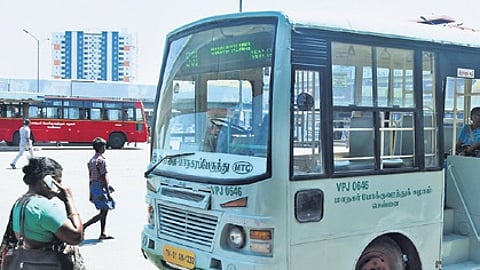

CHENNAI: The state government’s proposal to extend minibus services to more areas across the state seems to be facing headwinds as the Metropolitan Transport Corporation (MTC) and six other corporations of the Tamil Nadu State Transport Corporation (TNSTC), along with the employees’ federation of transport corporations, have opposed the plan at the public hearing conducted in Chennai on Monday by the Home (Transport) department.
The department issued a draft notification last month for a New Comprehensive Mini Bus Scheme 2024 to extend bus connectivity to more places across the state, including Chennai, Coimbatore, and other urban areas. Under the scheme, operators will be permitted to run buses up to a distance of 25km, with 17km on un-served routes and up to 8km on routes served by government or private buses. Currently, the maximum distance allowed for a minibus is 20km, with 4km allowed on served routes.
Speaking at the public hearing, Alby John Varghese, Managing Director, MTC, said that in continuation with the practice followed in metropolitan cities, private players should not be allowed to run buses in Chennai city.
He further mentioned that the draft notification permits the operation of minibuses in eight zones in extended areas of Chennai, designating them as unserved areas, though the MTC operates 1,700 buses in these areas. He stressed that a real-time monitoring system for minibuses should be established to prevent violations by operators before launching the scheme.
Of 6,500 permits in 1999, only 2,977 still active, say bus operators
R Ponmudi, MD of TNSTC (Salem), who voiced the views of six corporations, said that 40% to 45% of ticket revenue for town services of bus corporations comes from the first four stages of buses from their originating point. “The first four stages of town buses cover 7 to 8 km. If minibus operators are allowed to run buses for 8 km under the revised scheme, the earnings of town buses will be significantly impacted,” he said.
Meanwhile, minibus operators who are operating as per the existing scheme, demanded priority in permit allocation under the revised scheme. The bus operators said that since its inception in 1997, the minibus scheme had been unviable due to poor planning and implementation.
Of the 6,500 permits issued in 1999-2000, only 2,977 are currently active, and of them only 1,500 buses are in operation, they said.
Home secretary Dheeraj Kumar, transport commissioner Shunchonngam Jatak and other transport department officials took part in the public hearing held in Chennai. K Kodiarasan, president, TN Mini Bus Owners Federation, said that operators have been serving thousands of villages for nearly 25 years and want preference in permit allocation under new scheme.
He demanded an amendment to the draft notification which prescribes that origination and termination of minibuses should only be on unserved routes. “If buses terminate at unserved places, last-mile connectivity such as autos won’t be available for passengers. Either the starting or termination point should be a bus stand or another major junction,” he said. Sujatha Senthilkumar, a mini bus operator added, “Permits for auto rickshaws, which had been restricted for years, are now being issued if they run on CNG. If 25 auto rickshaws are stationed at every major junction, operating minibuses won’t be viable.”