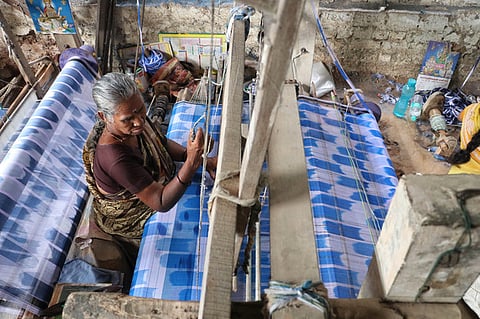

SALEM: It is hard times for handloom weavers in Salem as another monsoon is here.
As always, continuous rains have slowed production, tightened silk threads, and left many looms idle for days, adding to the struggles of a craft already fighting to survive. With declining production, the income of weavers takes a hit.
Also, worryingly, few new orders are in sight. V Devarajan, a member of the Salem Silk Weavers Cooperative Society, said weaving becomes almost impossible during this season. "Handloom is already in its declining stage, and the rainy season has added to its woes," he said. "When it rains, the loom becomes stiff and the silk threads tighten. The shuttle won't move smoothly, and we will lose days of work. If there is continuous rain for two days, our work will be completely stopped for five days."
The problem, weavers explain, lies in the nature of their material. Silk and cotton threads easily absorb moisture from the air, which makes them swell and tighten. The warp - the set of vertical threads stretched tightly across the loom - becomes rigid, so the shuttle that carries the horizontal threads cannot glide through smoothly. Wet fabric also takes much longer to dry, and continuous rain can stop production completely for several days. "We can weave properly only when there's sunlight," Devarajan said.
For weavers already finding it difficult to earn even Rs 10,000 a month, the rainy season has brought another round of hardship.
V Sreenivasan, another weaver from the same cooperative, said the rains have cut his monthly income by almost a third. "Even in good times, I could earn about Rs 10,000 a month," he said. "Now it's down to Rs 6,000 or Rs 7,000. Out of that, Rs 4,000 goes on rent. What's left is hardly enough for anything else. During rains, the work just stops. The monsoon seasons in previous years have also been hard, but at least during other months we could manage with sufficient production. This year, with very few orders coming in, the rains have made it even worse."
S Sekar, who has been weaving for more than 40 years, said this year's festive season felt unusually quiet. "Deepavali used to be our busiest time," he said. "This year, I couldn't feel that festive spirit even for a moment. I've been part of the Salem Silk Weavers Cooperative for four decades, but never seen it this bad. Younger weavers move to other jobs, but at 60, nobody hires me."
He also added, "I've depended on weaving all my life, but now it feels like the craft itself has abandoned me."
Salem, long known for its fine silk and cotton handloom fabrics, is witnessing a slow decline in its weaving tradition. Weavers cite a mix of problems - rising raw material costs, shrinking margins, delayed payments from cooperatives, and growing competition from mechanised looms.
The situation has been worsened by erratic weather and climate changes that directly affect production cycles. Many fear that if the trend continues, handloom may survive only as a government department, not as a living craft. "There will be offices and officials," Devarajan said, "but no real weavers left."
With production slowing through the monsoon and few new orders in sight, weavers in Salem say they are only hoping for conditions to improve in the coming months.
