
COIMBATORE: It’s the time to woo voters. The DMK and AIADMK cadres are leaving no stone unturned to win voters’ favour as they are all dressed to impress for the high-stakes elections.
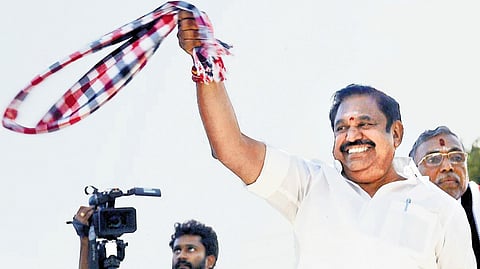
In Tamil Nadu’s political landscape, the simple ‘checked cotton towels’ (thundu) have emerged as powerful visual symbols in the current election. DMK cadres and leaders prominently wear black-and-red checked versions, while AIADMK supporters opt for ones mixed with white.
To visibly communicate their party and their ideological identity, political parties use party-coloured shawls, scarves, border vests and caps. Among these, the shoulder towel (thundu) holds special significance since a cloth draped around the neck or shoulder is traditionally seen as a mark of respect, having party symbols and colours. Coincidentally, in this election, the tradition has extended to ‘checked cotton towels’ and interestingly, it gets connection with a history spanning over a century.
“It was introduced all of a sudden and we do not know who started it, but the party instructed everyone to use these. Since it looked fresh and attractive, we all started using them,” said M Arulmozhi, a DMK member from Coimbatore, on cotton towels. AIADMK cadres also use it. They say the cotton towel comes in handy during poll campaigns, protecting them against the scorching sun and using it to wipe off sweat.

Leaders of the Dravidian movement said that the cotton towel culture was introduced nearly 100 years ago as a protest against caste discrimination. “Honouring marginalised community members by presenting them with a simple cotton towel was part of the social reform movement started by Periyar. Its historical roots are in the Dravidian movement,” said Kolathur Mani, president of Dravidar Viduthalai Kazhagam.
He said in 1924 a meeting was organised at Kaanadukathan by the Tamilar Iyakkam (later known as the Self-Respect Movement) led by Periyar to discuss the issues at Cheranmadevi Gurukulam. Incidentally, at that time, a nadaswara musician, Sivakolunthu, who was wearing a thundu over his shoulder, was forced to remove it on caste grounds.
Veteran leader Pattukkottai Alagiri objected it and alerted Periyar, who then launched a movement against caste discrimination. It was from that point the practice of honouring people oppressed by the caste system by making them wear a towel began, Mani said.
The practice evolved into providing it to leaders as well. Later Annadurai took it up, focusing on handloom towels to improve the livelihood of weavers, while the Congress focused on khadi clothes, Mani added.