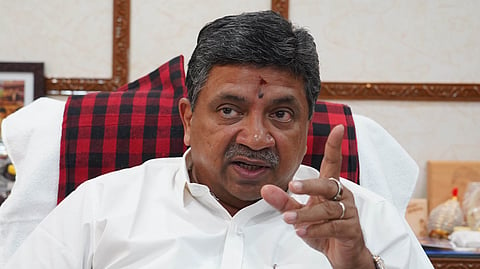

Minister for Information Technology and Digital Services Palanivel Thiaga Rajan (PTR), in a freewheeling chat with TNIE’s MS Thanaraj, discusses a range of issues from Tamil Nadu’s fiscal discipline, welfare expansion, the Madurai metro project and the impact of TVK in this election. Edited Excerpts:
The DMK government has significantly expanded its social welfare schemes in the manifesto. How is it planning to maintain fiscal discipline while sustaining these schemes?
The government follows two key principles. First, it ensures that all expenditures remain within the prescribed fiscal and debt limits. There is no unchecked borrowing. Second, it focuses on the outcomes of these welfare schemes, assessing whether they deliver meaningful, lasting benefits for society rather than being mere handouts.
Tamil Nadu’s experience shows that welfare and fiscal discipline can coexist. Despite implementing extensive social programmes, the state has stayed within its debt limits. At the same time, it has recorded strong economic performance, with around 11.19% real growth and 16% nominal growth in GSDP, indicating a healthy economy.
The broader point is that effective governance balances financial prudence with impactful welfare, keeping debt in check while public spending delivers tangible, long-term outcomes.
The opposition has alleged that the state failed to submit a revised report requested by the union government for the Madurai Metro. What are your thoughts on the issue?
The government submitted the detailed project report (DPR) in February 2024, which was returned by the centre, citing the lack of a comprehensive mobility plan and alternative analysis report. These were subsequently prepared and resubmitted in December 2024, addressing all deficiencies. The project is currently under consideration as part of the centre’s appraisal process. However, there has been no consistent explanation for the rejection.
At the same time, statements of BJP leaders like Piyush Goyal suggesting that the project’s approval depends on electoral outcomes or political alignment indicate a concerning level of politicisation. Infrastructure projects should be assessed on merit. Linking them to political conditions is unconstitutional.
There is a growing narrative of Tamil Nadu vs Delhi over fund allocation. Do you see a pattern?
No government in India’s history has used taxpayers’ money as a political tool the way the current union government does. Funds are being used selectively to reward BJP-ruled states. There is a clear pattern of step-motherly treatment. Despite this bias, non-BJP states are performing significantly better in governance, economic growth, and social outcomes compared to so-called “double-engine” BJP states. Interestingly, Tamil Nadu continues to perform well even without proportional support from the centre.
The TVK factor is being widely discussed in this election. What is your view?
You have to go by what you see on the ground. I appreciate his (Vijay’s) entry into politics because any democracy benefits from a vibrant political ecosystem with multiple participants. When a popular figure like Vijay enters politics, it naturally generates interest, especially among young voters who might otherwise not engage in the electoral process. In that sense, it is a positive development.
However, electoral success is not just about visibility or campaigning. It requires a strong organisational machinery to mobilise voters and ensure turnout on polling day. From my experience, focusing only on campaign sentiment is not enough. You also need a well-built system on the ground to convert that support into actual votes.
TVK has proposed the idea of AI university and regional IT hubs for tier-2 cities. What is DMK’s position on that proposal, and what is the government’s strategy for driving tech-led growth beyond Chennai?
Our focus is on distributed growth. We are expanding IT infrastructure through TIDEL parks in cities like Madurai and Coimbatore, along with smaller Neo TIDEL parks in tier-2 and tier-3 cities. Thousands of new jobs are being created, especially in regions like Madurai.
What is your vision for e-governance in Tamil Nadu?
We are moving towards data-driven governance. Databases across departments have been integrated to improve welfare delivery. E-Sevai centres have grown from under 8,000 to about 35,000, and online services have increased from 200 to 400. The future lies in AI-driven governance — Voice-Sevai, WhatsApp-based services, and AI assistants to help citizens access services easily.
What is your view on the Thiruparankundram deepathoon row?
There are several technical and legal aspects involved. As I understand, there was already an order from a two-judge bench, which ideally should take precedence over a single judge’s ruling. These legal matters will be addressed in due course. The issue will not have any impact on the election.
