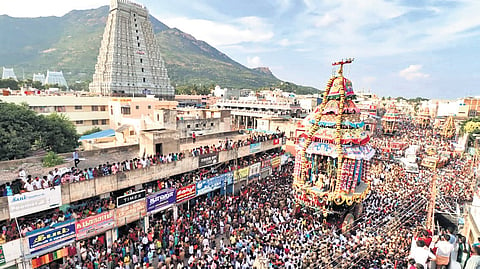

TIRUVANNAMALAI: Around Arunachala Hill, movement never pauses. By day and well into the night, a steady stream of pilgrims circles the 14-km Girivalam path, barefoot and in prayer, drawn to the Arunachaleswarar Temple that anchors the town’s rhythm and economy. Shops, eateries and roadside vendors thrive on this unceasing flow.
A few kilometres away, the pace shifts. Paddy fields and farmlands define rural livelihoods, far removed from the temple’s bustle. Yet, as Tiruvannamalai heads into the 2026 Assembly polls, this ‘spiritual capital’ is no longer just a site of devotion, it is fast becoming a politically contested terrain.
The constituency has remained a DMK stronghold, represented by Minister EV Velu, a six-time MLA. A former AIADMK leader who joined the DMK in 1997, Velu has held the seat since 2011.
In 2021, he secured 1,37,876 votes, defeating BJP’s S Thangavel by a margin of 94,673. As he seeks re-election, the opposition remains fragmented. The BJP has fielded Elumalai C, NTK has nominated Vignesh S, and TVK has entered the fray with Arul Arumugam, while the AIADMK has not fielded a direct candidate. However, the BJP’s rise from 1,935 votes in 2016 to over 43,000 in 2021 - signals gradual expansion.
Official data points to mounting pressure on infrastructure. The temple receives around 30,000 devotees on regular days, nearly one lakh on weekends, and an estimated 7-9 lakh on Pournami days. Police say managing crowds during peak events such as Karthigai Deepam remains a challenge. Officials also point to encroachments along the Girivalam path, with nearly 3,000 sannyasis estimated to be present as of 2025.
The constituency reflects a mixed social profile. Tiruvannamalai town comprises Mudaliars, Naidus and minority communities, including Christians and Muslims in areas such as Thenimalai, Pudhutheru and Katampundi. The rural belt is largely dominated by Scheduled Castes and Vanniyars, with agriculture as the primary occupation.
Within the DMK, confidence remains high. Party insiders attribute the continued dominance to Velu’s organisational strength and electoral track record. “Velu understands the opposition well and ensures the contest plays out on favourable terms,” a DMK source said.
However, ground reports suggest this confidence may be overstated, particularly in rural pockets where dissatisfaction is visible.
In Chinnakalapadi, transport access remains a concern. “My children study in Classes 11 and 10. Their school is 4 km away, and we walk 1.5 km to reach a bus stop. We have raised this repeatedly, but there has been no response,” said E Ramayi (43).
In Thatchampattu, residents flagged basic civic gaps. “During rains, sewage mixes with rainwater. We have submitted several petitions, but nothing has changed. There is no proper public toilet,” said P Venkateshan (60).
Water scarcity and quarrying have compounded concerns in nearby areas. “We receive only saline water through pipelines. For drinking water, we travel nearly 4 km daily. Quarrying has caused cracks in houses and dust pollution,” said Adhilakshmi E (36).
Farmers, too, point to unresolved issues. Concerns over SIPCOT land acquisition persist, while procurement infrastructure remains weak. “The direct procurement centre functions only for two to three months and lacks basic facilities. It must operate year-round,” said Lakshmanan, a farmer.
In the town, the scale of pilgrimage has created a different set of pressures. Devotees cite overcrowding, high accommodation costs and sanitation issues. “Darshan took four to six hours. Brokers offer quicker access for Rs 1,000. Lodges are expensive, and cleanliness along the Girivalam path needs improvement,” said Y Akash (22), a student from Hyderabad. The presence of TASMAC outlets along the Girivalam path has also drawn criticism.
Residents living near the temple say daily life has been affected. “Businesses have benefited, but we have lost our peace. During Karthigai Deepam, movement becomes difficult. Even locals have to wait hours for darshan,” said a resident near Rajagopuram, requesting anonymity.

Civic issues persist across urban pockets. “Vehicles are parked haphazardly. Garbage is dumped and even burnt near houses in the Eesanya Lingam area. Despite complaints, no action has been taken,” said Jothi K (64) of Thendral Nagar.
Within the DMK’s local structure, sources acknowledge gaps in grassroots engagement. Village-level in-charges have not been consistently active, contributing to anti-incumbency in certain pockets. Some also point to limited outreach beyond main roads.
Responding to these concerns, Velu said most issues raised by residents have been addressed, with a few pending due to administrative constraints. He added that efforts are under way to bring industrial opportunities through SIPCOT and to streamline temple access for local residents.
Rapid urban expansion has also raised concerns over encroachments around the hill. Following Tiruvannamalai’s upgrade to a corporation, notices have been issued, with several cases pending before the Madras High Court.
Politically, the DMK retains a clear organisational edge, while the AIADMK continues to grapple with internal divisions, limiting its ground presence. A BJP source claimed AIADMK cadres are largely absent from campaign activities.
Within the BJP, discontent over seat allocation has surfaced, even as the party attempts to expand by combining Hindutva messaging with local civic issues.
BJP candidate Elumalai C is focusing on local grievances. “People face unresolved issues, including overcrowding at the temple and lack of infrastructure. These will be my priorities,” he said.
Hindu organisations are also carrying out outreach, particularly in the outskirts, focusing on broader religious issues while seeking to expand vote share.
The entry of Tamilaga Vetri Kazhagam (TVK) has added a new dimension. Its candidate Arul Arumugam, founder of the Uzhavar Urimai Iyakkam, has a background in protest politics. He gained visibility during the agitation against the Salem–Chennai Expressway project and was detained under the Goondas Act in 2023 in connection with SIPCOT land acquisition in Melma. While supporters allege political targeting, Arumugam is projecting his candidature as a platform for farmers’ issues.
“The response has been encouraging. I feel equipped to take on a stronger opponent,” he said.
NTK candidate Vignesh S has framed the election around uneven development. “Interior areas remain neglected. Issues include garbage dumping, poor traffic management and lack of support for farmers,” he said.
As Tiruvannamalai moves towards polling, the contest continues to favour the DMK structurally. However, rural dissatisfaction, civic stress and a multi-cornered fight could influence the outcome beyond a straightforward narrative.
“The outcome here is predictable, but not the margin,” said Ramu Manivannan, former Head of the Department of Political Science at the University of Madras. “It will not be the same as the previous election. Vote split will determine the final positions.”