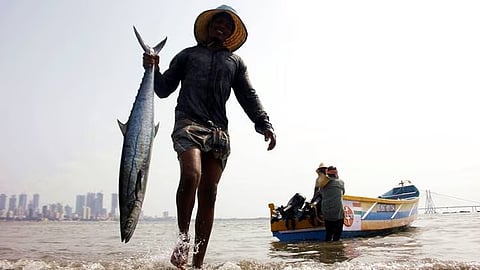

NAGAPATTINAM: On a night in December last when Cyclone Ditwah struck, 70-year-old fisherwoman A Anjamma of Chandirapadi in Mayiladuthurai began to recall past disasters as seawater fast advanced into the coastal village. “We were frightened to even open our doors and look out,” she said. Sugan, a local fisherman, said seawater enters the village in the event of rough tides as well, damaging boats and washing away fishing nets.
Elsewhere, in Pushpavanam of Nagapattinam, resident S Ramesh complains of the seabed being muddy. As a result, boats cannot move when the water level is low, forcing us to remain idle for days, he said. The project for a Rs 25-crore fishing harbour in the locality is yet to take off.
Meanwhile, in Ramanathapuram’s Roachma Nagar, Perinbam bemoaned illegal fishing in the territorial waters. “If it is not curbed, traditional fishermen will lose their only source of income,” he said.
Such complaints of ecological degradation, illegal practices and depleting resources, coupled with the more pronounced fishing conflict between the country and Sri Lanka, resonate across Tamil Nadu’s 1,076-km coastline spread over 14 districts. Compounding the situation is limited political representation, rue the state’s fishers.
On the Indo-Lanka fisher dispute, which has been leading to arrests of Tamil Nadu fishers and seizure of their boats by the island nation’s navy, P Jesuraj, president of the All Mechanised Boat Fishermen Association, said there are over 2,000 mechanised boats and around 25,000 fishermen and allied workers in the Rameswaram region. “Though the government provides around Rs 8 lakh for confiscated boats, the actual cost of a vessel ranges from Rs 25 lakh to Rs 1 crore,” he said.
Pointing to the norms requiring family members to wait for seven years before a death certificate can be issued for those fishermen going missing at sea, J Brisno Raymond from Olaikuda in Rameswaram said, “The waiting period must be reduced to one year so that affected families can receive compensation without prolonged hardship.” He also sought revival of the Ma Singaravelar Fisherman Free Housing Scheme for small-scale fishers.
In Thoothukudi, fishermen raise concerns over violations during the annual ban period. While the east coast observes a fishing ban from April 15 to June 14 and the west coast from June 1 to July 31, fishers allege that Kerala and Kanniyakumari boats aligned with the west coast cycle frequently enter Tamil Nadu’s territorial waters during the ban in effect along the east coast. “We have repeatedly urged officials to prevent this, as it defeats the ban’s purpose,” said A John Xavier, member of a mechanised fishermen’s welfare association.
The “neglected” political representation of the fisher community in the Assembly leaves way for increasing disappointment, not hope that their situation would change for the better.
“Fishermen have the strength to decide electoral outcomes, yet our representation has steadily declined. Who will speak for us if not our own representatives? Without adequate recognition, we are made to feel like refugees in our own land,” said R M P Rajendra Nattar, president of the Indian National Fishermen Union.
Infrastructural and systemic gaps continue to disrupt livelihoods in equally damaging ways. In Nambiyar Nagar, when officials cited inadequate funding for a harbour, residents took loans to the tune of Rs 1 lakh per head under the self-sufficiency scheme, ‘Thanniraivu Thittam’, in 2019, to have it built, effectively shifting the burden of a public project onto the community.
“The total cost was Rs 34 crore, of which we contributed Rs 11.43 crore after the government refused full funding. We couldn’t repay [the loans] as our livelihoods were hit by the purse seine ban and later the lockdowns,” said T Vel, a community leader. S Sinduja, a local fisherwoman who contributed to the project, said, “My Cibil score has worsened. I can’t access any loans, and I fear it will affect my daughter’s education.”
The absence of cold storage facility is another point of contention for the fishers of Nagapattinam.
“There are at least 200 vessels in Akkaraipettai. We are forced to sell the catch immediately at whatever price is offered, as supply exceeds demand and we cannot risk spoilage. We invest Rs 4 lakh to Rs 5 lakh per trip but earn only up to Rs 50,000 in profit. If the catch is poor, we stare at a loss. With a storage unit, we could hold the catch and sell later at better prices,” said S Selladurai, a fisherman from Akkaraipettai.
As for coastal villages in Ennore on the outskirts of Chennai, which are surrounded by red-category industries, they bear the brunt from industrial pollution. “Discharge into the Kosasthalaiyar river, CPCL plant leakage, ash leakage and ammonia gas accidents have devastated the marine ecosystem. People avoid buying fish here due to the oil odour and taste. The village has become uninhabitable,” said R Arumugam of Nettukuppam.
Meanwhile, P Justin Antony, founder president of the International Fishermen Development Trust (INFIDET), said rising ship-boat collisions have emerged a serious threat, claiming fishers’ lives. He called for demarcated sea routes, stronger harbour surveillance, and better monitoring of shipping lanes.
Women vendors from the community have their own set of challenges. “They often arrive as early as 2 am to procure fish but are outbid by larger players, forcing them to settle for low-value catch. Inadequate facilities, including storage, sanitation, lighting and potable water, further worsen working conditions, while lack of transportation and market access restricts earnings. With minimal social security and limited credit access, many remain financially vulnerable,” said S Velvizhi of the MS Swaminathan Research Foundation.
Despite the challenges, fishermen fear the occupation may not survive another generation, as younger members move to cities or abroad for education and work. “I have a vessel and a shop but I’m afraid there will be no one after me to take care of it. My children have taken different paths,” said Selladurai.