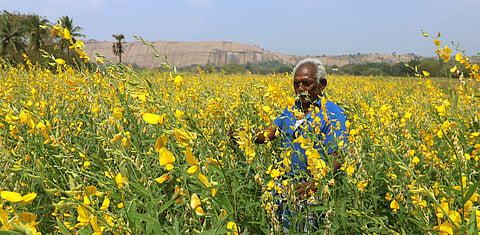

CHENNAI: The Tamil Nadu government has announced a series of new initiatives in the revised agriculture budget for 2026-27, focusing on soil restoration, artificial intelligence, climate resilience, crop diversification and value addition to improve farmers’ incomes.
The flagship announcement is the Tamil Nadu Soil Fertility Mission, a five-year programme with an estimated outlay of Rs.600 crore. During 2026-27, the mission will be implemented with an allocation of Rs.122.51 crore to improve soil health through incentives for organic farming, green manure cultivation, vermicompost units, Soil Health Cards, bio-fertilisers and carbon farming initiatives.
In a major technology initiative, the government has announced the Uzhavar Artificial Intelligence (AI) Scheme, allocating Rs.2 crore to provide farmers with AI-based advisories on weather, soil health, pest and disease management, crop recommendations, market intelligence and government schemes through mobile phones.
To reduce dependence on imports, the government will launch a Mission for Self-Sufficiency in Pulses and Oilseeds with a total outlay of Rs.203.64 crore.
A Cotton Renaissance Mission has also been announced to boost cotton production through high-density planting technologies and improved cultivation practices.
The budget introduces a Tamil Nadu Minor Millet Mission covering 29 districts, besides announcing demonstration projects for introducing nutrient-rich crops such as quinoa, buckwheat and brown-top millet.
Responding to increasing crop damage caused by wild animals, the government has launched a Wild Boar Damage Prevention Scheme with an outlay of Rs.7.35 crore.
The scheme includes subsidised wild boar repellents developed by Tamil Nadu Agricultural University, solar-powered fencing and removal of invasive Prosopis juliflora to reduce wild boar habitats.
A new Annal Ambedkar Agricultural Assistance Scheme has been announced for Scheduled Caste and Scheduled Tribe farmers with an allocation of Rs.56.72 crore.
It provides enhanced subsidies for high-value agricultural infrastructure and 100% subsidy for irrigation facilities in rainfed lands.
In the horticulture sector, the government has introduced the "Vetri Illatharasi Veetu Thottam" scheme with Rs.10 crore to promote home gardens in urban apartments and rural households.
It has also announced a Tamil Nadu Micro Greens Scheme with Rs.1.20 crore to popularise microgreen cultivation in major cities.
The budget also announces the establishment of a Tamil Nadu Coconut Processing Corporation to support value addition, processing, packaging and exports of coconut products, fulfilling a long-standing demand of coconut growers.
Among the other new initiatives are a special scheme for coconut, promotion of high-value fruits such as blueberries, avocado and dragon fruit, encouragement for tamarind cultivation in rainfed areas, establishment of mushroom production units, expansion of medicinal crop cultivation, new onion storage infrastructure, and farmer recognition through the Makkal Sevagar Anjalai Ammal Award, Vetri Vivasayi Award and Nammazhvar Award for excellence in farming.
Overall, the newly announced schemes indicate a policy shift towards technology-driven farming, climate adaptation, diversification into high-value crops and strengthening post-harvest value addition, while seeking to improve farm incomes through sustainable agricultural practices.
