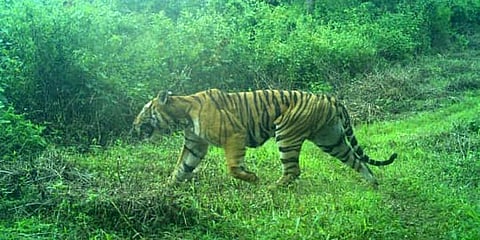

COIMBATORE: Three days after a 58-year-old man was allegedly killed by a big cat at Lauriston in O-Valley near Gudalur, forest officials are yet to get the images of a tiger from the camera traps installed in the area. With no signs of the animal's movement despite the installation of 16 camera traps, officials suspect that the tiger may have moved into a nearby forest range.
Following this, instructions have been issued to the forest range officers of Naduvattam in the Nilgiris Forest Division and Gudalur Forest Range to intensify monitoring and track the animal's movement, as both ranges are adjoining Lauriston in O-Valley forest range.
Officials suspect that the tiger could have moved into a nearby forest range soon after the incident, possibly due to increased human presence in the area. The forest staff began installing camera traps following the incident, while media personnel also started visiting the locality to cover the incident.
Gudalur Forest Division District Forest Officer (DFO) P Devaraj said the number of camera traps had been increased to 20 on Wednesday to improve the chances of recording the tiger's movement.
"We can determine whether the animal is injured or old only after obtaining its images. There is a possibility that a tiger may turn to human beings as prey if it is injured or old and unable to hunt its natural prey, forcing it to look for easier prey such as cattle," he said.
The official added that the big cat might have mistaken Balakrishnan for prey while he was in a crouching position.
Devaraj also confirmed that the animal had not been spotted even by a drone deployed by the forest staff to search for possible hiding places in bushes and patta lands in the locality.
He further said doctors who conducted the postmortem examination were still unable to conclusively determine whether a tiger or a leopard had attacked and killed 58-year-old Balakrishnan. "We will be sending the swab samples to the Advanced Institute for Wildlife Conservation (AIWC) for further examination," he said.
However, sources said forest officials were of the view that a tiger could have killed Balakrishnan, but were reluctant to reveal the possibility publicly in view of potential law-and-order issues.
