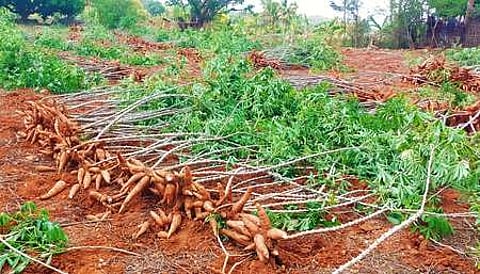

SALEM: Tapioca farmers in the hill regions of Salem are facing difficulties during the ongoing harvest season, with inadequate rainfall and dry soil making it difficult to uproot the tubers and raising concerns over reduced starch content and lower returns. The problem is mainly reported in the Kalvarayan Hills, Pachamalai and Karumandurai, where tapioca is predominantly rain-fed.
Unlike tapioca cultivated in the plains, where the harvest season is yet to begin, tapioca grown in the hills is generally harvested between June and August, with most of the crop harvested by July. Farmers said the lack of adequate rain during both cultivation and harvesting had affected the crop and made it difficult to harvest it at the right time.
Tapioca is an underground crop and requires adequate soil moisture for harvesting, as moist and loosened soil makes it easier to uproot the tubers without damaging them. In the absence of rainfall, the soil in the hill regions has remained dry and hard, making manual harvesting difficult. Unlike in the plains, where irrigation can be used to wet the soil, tapioca cultivated on the hill slopes depends largely on seasonal rainfall.
Farmers said they were often forced to harvest whenever there was some rainfall rather than during the ideal harvesting period, resulting in premature or delayed harvesting. Delayed harvesting can reduce the starch content of the tubers, while premature harvesting can affect their quality and yield, they said.
"Tapioca farmers in the hills have faced difficulties right from cultivation because of inadequate rainfall. We cannot depend on irrigation to wet the soil during harvesting and have to wait for rain. This year, farmers had to harvest whenever there was some rain, which affected the timing of harvest and the starch content and quality of the crop," said S. Jayaraman, a tapioca farmer.
Starch content is particularly important for tapioca farmers as the crop is supplied to sago processing units, where the price is determined by its starch content rather than simply by raw weight. The tubers are assessed using a point-based measurement system, with higher starch content generally fetching better prices.
Farmers said tapioca cultivated in the hills normally has a relatively higher starch content, often around 28%-30%, but the dry conditions this season have affected the levels. "The point, as farmers call the starch percentage, has now fallen below 24%. Normally, tapioca grown in the hills would have a starch content of more than 28%," said N Chelladurai, a farmer from Pachamalai.
The current price of tapioca is around Rs 12,000 to Rs 14,000 a tonne, depending on the starch content. Farmers said they could have fetched better prices if the crop had received adequate rainfall and developed higher starch levels.
Salem District Farmers' Welfare Association president V S Govindaraj said the lack of soil moisture has also affected the application of top-dressing fertilisers, as hill farmers depend on rainfall to dissolve and carry nutrients to the root zone.
"Applying fertiliser to dry soil can damage the crop instead of helping it. The lack of moisture also increases the possibility of tubers breaking while farmers try to uproot them. When the soil is dry and hard, even manually removing the tubers becomes difficult," he said.
Govindaraj said the area under tapioca cultivation has already declined since the farmers have been selling for poor prices over the past two years, with pest attacks adding to their concerns this season.
According to the horticulture department, 1,918 hectares of tapioca cultivated in the hill regions have been harvested this season, with estimated production of 42,196 tonnes, based on an average yield of around 22 tonnes a hectare. Farmers said the yield could have reached around 30 tonnes a hectare with favourable rainfall.
