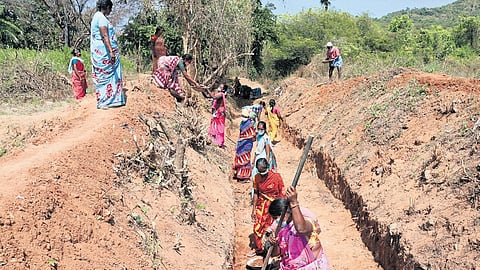

CHENNAI: The Tamil Nadu government is expected to bear an additional financial burden of around Rs 5,000 crore annually following the rollout of the Viksit Bharat-Guarantee for Rozgar and Ajeevika Mission (Gramin) (VB-G RAM G), which replaced the Mahatma Gandhi National Rural Employment Guarantee Act (MGNREGA) scheme from Wednesday, officials said.
The increased burden stems from a significant change in the centre-state funding pattern.
Under MGNREGA, the centre bore the entire wage cost for unskilled labour, all administrative expenses and 75% of the material cost for civic works, while the state government was required to contribute only the remaining 25% of the material cost.
But now, under the new scheme, the funding ratio has been revised to 60:40, with the centre contributing 60% and the state 40% of the expenditure across all three components — wages, materials and administrative expenses.
“The annual expenditure under MGNREGA averaged between `10,000 crore and `12,000 crore. Of this, the state’s contribution was only around `1,000 crore, with the centre bearing the rest,” a Rural Development and Panchayat Raj department official told TNIE.
Since wages account for nearly 80% of the scheme’s expenditure, the state will now have to shoulder 40% of wage and administrative costs in addition to its share of material expenses. Officials estimate this will require an additional `4,000 crore-`5,000 crore every year, forcing the government to make additional budgetary provisions in the coming years.
The official added that the centre’s annual allocation for the scheme is based on the state’s performance and the number of workers employed, and based on this amount, the state will release a nominal fund needed for the scheme.
For the current financial year, the centre has allocated `7,585 crore under VB-G RAM G, while the state has earmarked around `2,000 crore in its interim budget.
CM writes to PM
Chief Minister C Joseph Vijay on Wednesday wrote to Prime Minister Narendra Modi seeking modifications to the scheme, particularly its funding pattern. He also requested the PM to continue the scheme in the name of Mahatma Gandhi to honour his legacy.
In a statement, he urged the centre to retain the earlier MGNREGA funding formula, arguing that the revised pattern under VB-G RAM G would impose an additional financial burden on Tamil Nadu, which may reduce employment days or crowd out other essential welfare schemes.
Vijay also sought flexibility for states in classifying village panchayats and allocating funds. Referring to the provision requiring states to notify a fixed 60-day period each financial year during peak sowing and harvesting when works are suspended, he said climate variability, including El Niño conditions, often disrupts agricultural cycles, creating unseasonal labour demand.
The CM further urged that the power to notify the 60-day period be decentralised to district collectors so it can be declared dynamically based on local conditions.
Vijay also sought inclusion of state-funded rural housing schemes under the VB-G RAM G convergence framework, which currently covers only union government housing schemes.
