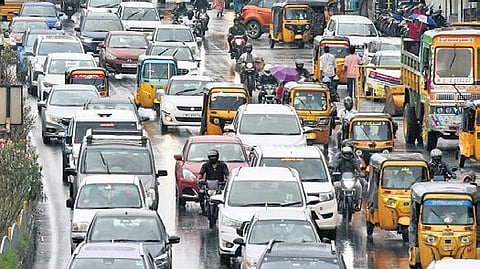

CHENNAI: The government seems to be waging a losing battle in encouraging more people to use public transport in the state’s capital as private vehicles now account for more than 65% of motorised trips in the Chennai Metropolitan Area (CMA). The share of public transport in daily trips in CMA has registered an 11% dip in the last 35 years, official data show.
Though metro rail network, bus fleet, and suburban rail services have all been introduced and expanded over the last three decades, the share of usage of public transport has dropped from 42% in 1991 to 31% in 2026.
The Second Master Plan (SMP) conceived in 2005, as part of which projections for the city’s growth were laid out till 2026, had estimated that public transport would account for 70% of all motorised trips in Chennai by this year, but private vehicles now account for 65% of such trips.
The SMP had projected around 2.07 crore daily trips across the CMA in 2026, close to the 2.13 crore now estimated by the Chennai Unified Metropolitan Transport Authority (CUMTA). Of this, the SMP said 1.45 crore daily trips would be made through public transport.
Commuters cite poor connectivity, lack of parking near transit nodes
In reality, however, only about 51 lakh trips are currently made using public transport modes, roughly 24% of CUMTA’s total trip estimate.
Cars and two-wheelers now account for about 45% of all trips, auto-rickshaws for 5.7%, and walking and cycling for around 26%. Bus trips, too, have fallen short of the SMP projection, which had estimated 87 lakh daily bus trips by 2026, but the city currently records only 39 lakh trips.
According to a study conducted by the Institute for Transportation and Development Policy (ITDP) last month, the current fleet of buses in the city remains insufficient. It recommended that MTC deploy 520 mini buses to improve connectivity between residential areas and major transport corridors, and expand school bus routes.
Commuters who use trains and buses cite poor last-mile connectivity and a lack of parking near transit nodes as key deterrents. “My office is in Egmore. If I take a suburban train from Kodambakkam, I can reach Egmore within 10 minutes.
But I still ride my two-wheeler for 20 minutes to the office as I cannot walk to Kodambakkam railway station from my home in Choolaimedu since it would take at least 20 minutes,” said S Vimalkumar, a Choolaimedu resident, adding that he would switch to trains — a cheaper option — if connectivity to the station or safe parking were improved.
CUMTA special officer I Jeyakumar said the number of MTC buses had stagnated for years, while the suburban rail network covers only 250 km. “After several initiatives, the number of buses was increased to 4,000 recently.
Unlike other metropolitan cities that grow vertically, Chennai grows horizontally. Due to this, public transportation is not available to residents in suburban areas. The share of two-wheelers in the city has increased from 7% to 40% over the last three decades,” he said.
