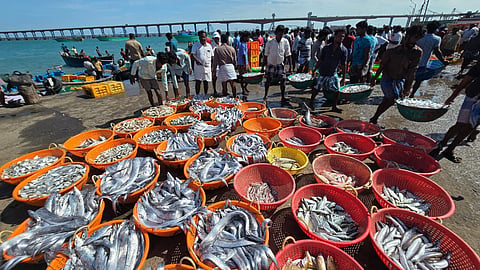

CHENNAI: Tamil Nadu's deep sea fishing communities are pressing for approval of data-enabled two-way satellite communication aboard vessels, arguing the technology could reshape the economics and safety of an industry that has long operated largely out of contact once boats move beyond sight of land.
The National Association of Fishermen (NAF) has petitioned Jyotiraditya Scindia, the union communications minister, for clearance to deploy satellite-based services, saying current vessel-monitoring systems offer little more than location tracking and basic text messaging and expensive two-way calls at Rs 25 per minute. The demand comes even as the Union government seeks to expand deep-sea fishing.
The Department of Fisheries has issued deep-sea access passes allowing fishermen to target high-value species such as yellow fin tuna, kingfish, swordfish and sailfish. Fishermen argue that encouraging vessels to operate farther offshore without providing dependable two-way communication leaves a critical gap between policy ambition and operational reality.
J Mahiban, managing director of ABJ Impex and a veteran of the fishing industry, said real-time connectivity would let fishermen receive live weather forecasts, oceanographic data and fish-movement information at sea. This will help vessels target catch more efficiently while steering clear of dangerous conditions without abandoning trips altogether, cutting both fuel costs, lost fishing days and e-commerce.
Praveen Kumar, NAF Tamil Nadu state president, said many fishermen working in the Bay of Bengal and the Gulf of Mannar avoid venturing beyond 200 nautical miles because they have no reliable way of summoning help in an emergency. "If an accident occurs or a fisherman falls ill at sea, we have no way to contact anyone," he said.
Market access stands to improve as well. Unlike farmers, who receive price and weather updates on mobile phones, fishermen currently return to port with no knowledge of prevailing prices, Mahiban said. Two-way communication would allow them to share images of the catch and negotiate directly with buyers while still offshore, securing better returns on fresh catch rather than accepting whatever price awaits them at the harbour.
A further benefit, industry representatives say, lies in dispute resolution. With live satellite tracking, the position of every fishing vessel could be monitored round the clock by government security agencies, state fisheries departments and boat owners alike. It would also make it far harder for boats to stray into restricted or contested waters undetected.
A fisheries department official told The New Indian Express that the current satellite phones are effective till 200 nautical miles. "The ISAT-Phone 2 will lose satellite signal so it can’t keep continuous connection with satellite. The state has written to the Centre multiple times to provide new data-enabled phones,” he said.
The official stated that currently the Indian Fisheries Departments does not issue or support Starlink phones. Instead, for deep-sea fishermen safety, the Department of Fisheries relies on subsidised BSNL satellite phones (Satphones), NavIC transceivers, and VHF radio sets. “Centre is contemplating to upgrade it using Starlink technology,” he added.
Mahiban said his company had done pilots on two-way data-enabled satellite systems on vessels off Kerala, Tamil Nadu and Karnataka, maintaining uninterrupted contact on voice and video calls and live CCTV with boats more than 300 nautical miles offshore. He argued that the technology is ready for wider deployment. What remains, fishermen say, is regulatory approval to bring it to the rest of the fleet.
The stakes are considerable given the scale of India's registered mechanised fishing of 64,414 suited to deep-sea operations, according to the ministry of fisheries, underscoring the reach that improved connectivity could have if rolled out fleet-wide.
