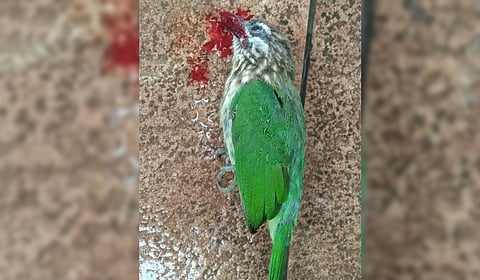

COIMBATORE: The death of a White-cheeked Barbet, an endemic species of the Western Ghats, after it collided with a glass surface near Coonoor has once again highlighted the importance of adopting bird-friendly building designs to prevent bird deaths and injuries. The White-cheeked Barbet primarily inhabits the upper canopy of tall trees and plays a vital role in maintaining forest ecosystems by dispersing seeds.
M Siraj Deen, Coimbatore Coordinator of the Wildlife and Nature Conservation Trust (WNCT), who photographed the White-cheeked Barbet after it died in a collision with a glass surface, said, "The loss of a rare bird is not merely the death of an individual. It is a loss to the rich biodiversity and natural heritage of the Western Ghats. It is time to act to prevent such deaths, as many bird collisions go unreported."
Siraj Deen said his team, along with Ongil Nature Trust, an environmental group based in Coonoor, conducted a study which found that, out of 35 collision incidents involving 22 species from 15 bird families in the Forestdale and Coonoor areas alone, 16 birds died and 18 were injured after striking glass surfaces. The Indian Blue Robin (Luscinia brunnea) recorded the highest number of collisions, followed by the Greenish Warbler (Phylloscopus trochiloides), Kashmir Flycatcher (Ficedula subrubra), and Grey Wagtail (Motacilla cinerea). Among the resident birds, the White-cheeked Barbet and Spotted Dove were the most affected.
The number of bird deaths has since increased significantly. In a recent study, the bird enthusiasts documented 56 bird deaths due to glass collisions, underscoring the urgent need for preventive measures. "Such incidents are not confined to Coonoor alone. Similar bird collisions are being reported from Kotagiri and Ooty as well," Siraj Deen said.
"Apart from making bird-friendly building design guidelines mandatory while granting approvals for new buildings, awareness programmes should also be conducted among the public, building owners, developers and government departments on adopting bird-safe construction practices," Siraj Deen added.
Siraj Deen and A Azad Kamil, founder of Ongil Nature Trust, also demanded measures such as shifting vegetation away from reflective glass surfaces and installing bird-safe windows using circular decals, UV-reflective patterns, patterned or anti-reflective glass, and other bird-collision deterrents to reduce the risk of bird strikes.
Azad Kamil expressed disappointment that despite submitting a petition to the Nilgiris district administration and DFO during the second week of November 2025, bird deaths due to glass collisions have continued unabated, with no concrete measures taken to prevent them
When contacted Nilgiris DFO Kashyap Shashank Ravi told TNIE that he will look into the issue and he will soon conduct a meeting with the building contractors association and take steps to prevent such incidents in future.
