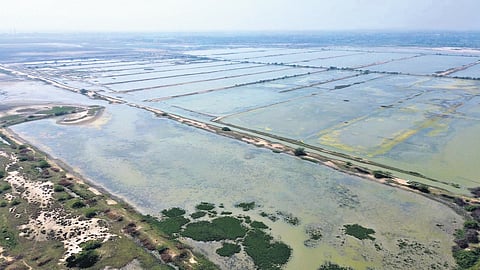

CHENNAI: The IIT Madras has found that the proposed Mamallan (Kovalam sub-basin) reservoir is hydrologically feasible to store 1.655 thousand million cubic feet (TMC) of rainwater, while recommending several refinements to strengthen flood modelling, hydraulic design and operational planning before implementation.
The findings are part of the technical evaluation submitted along with the Tamil Nadu government’s additional counter-affidavit before the southern bench of the National Green Tribunal in the challenge against the project.
The proposed reservoir, spread over 17.71 sq km with a storage depth of three metres, is designed to store 1.655 TMC in a single filling and an annual storage of 2.25 TMC.
According to the report, it would augment groundwater recharge, help check seawater intrusion and supply up to 170 million litres a day (MLD) of drinking water for nearly nine months every year.
The technical evaluation was prepared by Soumendra Nath Kuiry, associate professor, department of civil engineering, IIT Madras, and S A Sannasiraj, professor, department of ocean engineering, IIT Madras, following a joint site inspection with water resources department (WRD) officials.
The report notes that the proposed coastal reservoir has an overall catchment area of 414.08 sq km, of which 296.42 sq km is intercepted through a cascade of 69 irrigation tanks, while the remaining 117.66 sq km forms the free catchment feeding the reservoir.
Hydrological simulations, based on 31 years of rainfall data from the Kelambakkam rain gauge station and adopting the 75% dependable rainfall year (1987), estimated a total run-off availability of 4.25 TMC and a dependable annual yield of 2.97 TMC. The institute said that the model and available data support the feasibility of storing 1.655 TMC in the proposed reservoir.
IIT Madras also compared its findings with an independent hydrological assessment by the Centre for Water Resources, Anna University, which estimated a 75% dependable yield of 2.47 TMC. The report states that the two studies are broadly consistent and indicate that sufficient surplus run-off is available for reservoir storage while retaining environmental flows needed to sustain the coastal and estuarine ecosystem.
However, the institute advised using more rigorous flood estimation methods, calibrating the hydrological model with observed field data, validating it against the 2015 and 2021 Chennai flood events, and carrying out detailed hydraulic simulations comparing scenarios with and without the reservoir. It also recommended considering additional outlets to discharge excess flood water directly into the sea and ensuring peripheral off-take channels remain free from encroachments.
In its compliance report, the WRD stated that hydrological studies carried out independently by the Anna University and IIT Madras, based on 40 years of rainfall data, land use, soil characteristics and upstream irrigation tank storage, produced closely matching results and concluded that the reservoir is hydrologically feasible to harvest 1.655 TMC of rainwater.
‘Use more rigorous estimation methods’
However, IIT-M advised using more rigorous flood estimation methods, calibrating and validating the hydrological model with observed field data, and carrying out detailed hydraulic simulations
