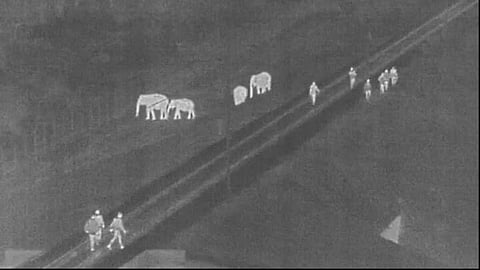

COIMBATORE: Department of Environment, Climate Change and Forests Additional Chief Secretary Supriya Sahu said that the artificial intelligence-based camera system, installed along the railway tracks in Puthupathi village in Madukkarai Forest Range, has generated more than 7,116 real-time alerts regarding animal movement, leading to 3,281 instances of loco pilots stopping or slowing down trains to facilitate the safe passage of wild elephants over the last two-and-a-half years. Sharing the data on social media, she said the forest department's mission to bring elephant deaths on railway tracks down to zero has been successful.
A dedicated team, comprising forest officers, frontline patrol staff, loco pilots, drone operators, and the AI-powered round-the-clock Elephant Control and Command Centre, at Puthupathi has been working to ensure the safety of elephants. After receiving alerts from the 24 AI cameras, field staff prevent elephants from approaching the track and drive them away to ensure their safe crossing. "These are the unsung heroes whose constant vigilance, dedication, and hard work have facilitated around 9,481 safe elephant crossings, ensuring zero elephant deaths on railway tracks and demonstrating how technology, human vigilance, and teamwork can come together to protect wildlife," said Supriya Sahu.
Further, she said the system has also detected deer, gaur, and leopards, creating a comprehensive AI-enabled wildlife monitoring network. "We inform the station masters at Walayar and Ettimadai through intercom and they alert loco pilots through walkie-talkies to slow down trains," a field staff member of the Madukkarai Forest Range said.
Sources said the locations of elephants are also shared through a WhatsApp group comprising officials from the forest department and the railways. Besides AI cameras, AI-powered drones have also been deployed for wider landscape surveillance, extending monitoring beyond fixed thermal cameras and providing real-time situational awareness of elephant movements.
