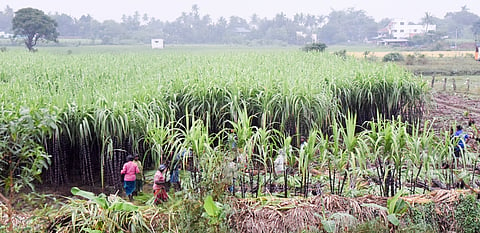

TIRUCHY: Sugarcane farmers have described the union government’s decision to fix the Fair and Remunerative Price (FRP) for the 2026-27 sugar season at Rs 3,600/tonne as inadequate, and said the government did not take into consideration the rising cost of cultivation while revising the price.
The Union government recently announced FRP of Rs 3,600/tonne, an increase of Rs 100/tonne for the 2026-27 sugarcane crushing season (October 1 to September 30). “The rate is neither fair nor remunerative, as it does not reflect the actual cost of cultivation, said S. Vimalnathan of Swamimalai, secretary of the Tamil Nadu Cauvery Farmers’ Protection Association.
“All input costs have increased significantly over the years, but farmers have not received a profitable price. Based on the current cost of cultivation, the FRP should be at least Rs 5,500/tonne. The revised FRP is disappointing,” he said. Sugar mills earn revenue not only from sugar production but also from by-products such as electricity generation, paper manufacturing, ethanol production, fertilizers and other value-added products. The union government should ensure that farmers receive a reasonable share of these profits through the FRP, said KST Angamuthu, a farmer from Koppavali near Lalgudi.
“We spend around Rs 45,000-Rs 50,000 to cultivate sugarcane on one acre, but get only Rs 55,000 -Rs 60,000. I used to cultivate sugarcane on 10 acres but reduced the area to five because cultivation is no longer profitable,” he said.
P Ramasamy, president of the Arignar Anna Sugar Mill Cane Growers’ Association, said the sugar mill in Thanjavur once crushed around six lakh tonnes of sugarcane annually. The quantity has now fallen to about 1.4 lakh tonnes as the area under sugarcane cultivation in the district has shrunk from about 15,000 acres to around 3,500 acres, he said. He urged the revision of the FRP to a level that is commensurate with the steadily rising cost of sugarcane cultivation.
