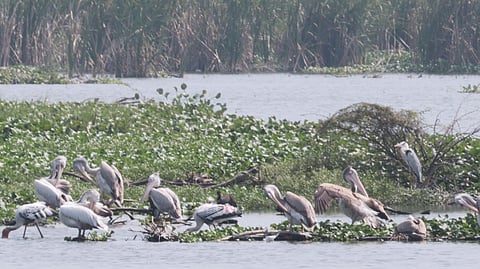

RAMANATHAPURAM: The Gulf of Mannar, one of India’s most important wintering grounds for migratory shorebirds along the Central Asian Flyway, has witnessed a steep decline in bird numbers over the last four decades, with overall shorebird abundance dropping by nearly 57%, according to a peer-reviewed study published recently in the journal Regional Environmental Change.
The study, led by H Byju of the Centre of Advanced Study in Marine Biology, Annamalai University, analysed shorebird populations across four survey periods between 1985 and 2024 at Dhanushkodi, Pillaimadam, Manoli Island and Valinokkam lagoons in the Gulf of Mannar Biosphere Reserve. The study was co-authored by H Maitreyi, K M Aarif, and S Ravichandran. Researchers recorded 40 shorebird species during the study period but found that around 60% of regularly occurring species had declined by more than 50%. At consistently monitored sites, the decline was even steeper at nearly 70%.
Among the species showing major declines were the Siberian Sand Plover and Curlew Sandpiper, both historically dominant winter visitors to the Gulf of Mannar. In contrast, generalist species such as the Kentish Plover, Greater Sand Plover, and Green Sandpiper showed increasing trends.
The researchers also documented a species turnover of nearly 30% between 2018-19 and 2021-22, with six species, including the recently recognised Hanuman Plover, recorded during the latest surveys.
Speaking to TNIE, H Byju said, “While species richness appears relatively stable, the sharp decline in abundance shows that the ecological health of the Gulf of Mannar is deteriorating. Losing individuals from specialist species is a far more serious conservation concern than simply counting the number of species present.”
Researchers noted that road construction and increased human activity at Dhanushkodi may have altered feeding habitats, while mangrove expansion at Manoli Island has reduced mudflat areas preferred by several migratory shorebirds.
The study also identified the man-made Valinokkam lagoon as an important supplementary habitat supporting several species that have declined elsewhere.
