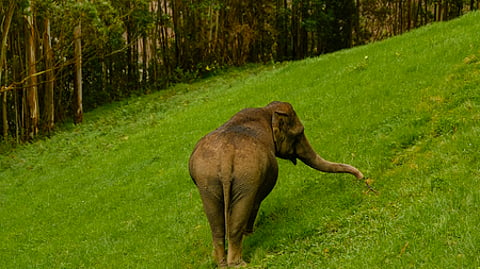

COIMBATORE: The population of wild elephants in the state has remained stable over the last 10 years, hovering around 3,000, said Chief Wildlife Warden Rakesh Kumar Dogra on Friday.
While there may be an increase in elephant numbers in certain areas, it cannot be concluded that the overall elephant population has increased, he said. However, he pointed out that the same is not true for human population, adding that cultivation has expanded till the doorstep of forests.
“Most of the buffer zones, which were revenue hillocks and poramboke lands earlier, have been encroached upon. Scarcity of food and water in forests is not the issue. However, the concentrated availability of sugary food, mainly agricultural crops near reserve forests, acts as a major artificial attraction for wild elephants, leading to increased human-animal conflict,” Dogra said.
He was speaking on human-animal conflict in Tamil Nadu during a panel discussion with the chief wildlife wardens of Kerala, Jharkhand and West Bengal at the National Workshop on Human-Wildlife Conflict, held at the Central Academy for State Forest Service (CASFOS) in the city
“The state witnesses more than 80 human deaths annually due to human-wildlife conflict, of which around 60 are caused by human-elephant interactions. However, most of these deaths are accidental. Elephants have a large movement range and often move across state boundaries. Corridor connectivity is the key to reducing conflict. We started the process to secure our first elephant corridor at the Sigur Plateau, which was the first legally notified elephant corridor in the country. However, the corridor is facing legal hurdles, with a number of cases pending before the Supreme Court,” Dogra pointed out.
He said acquiring land for elephant corridors remains a major challenge due to a lack of funds.
“We have estimated that around Rs 3,000 crore will be required to acquire land for elephant corridors. Funding constraints have affected our initiatives. As many as 41 elephant corridors have been identified, and we are in the process of notifying them,” he said.
Dogra said a model needs to be developed that allows people to retain ownership of their land while ensuring free movement of elephants through the corridors.
He also said Tamil Nadu has stopped using crackers and high-intensity lights to drive elephants back into forests. “Elephants eventually overcome all the barriers created by the forest department, including elephant-proof trenches and solar fences. There is no permanent solution,” he said.
Kerala Chief Wildlife Warden P Pugazhendi said one of the significant developments in 2024 was Kerala declaring human-wildlife conflict a state-specific disaster, similar to Odisha’s decision to declare snakebite a state-specific disaster. “It is no longer the responsibility of the forest department alone. Line departments such as the police and district administration have also become involved, and it is a very good decision taken by the previous government,” he said.
