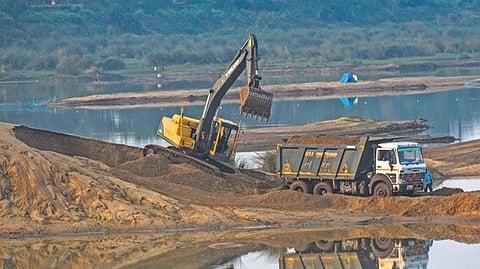

CHENNAI: About 31 months after river sand quarries in Tamil Nadu were shut down following raids by the Enforcement Directorate (ED) for alleged tax evasion and illegal extraction of sand, around 10 to 12 quarries are set to reopen. Most of the proposed quarries are expected to be reopened in the delta districts and adjoining regions.
The move is expected to reduce dependence on M-Sand and P-Sand, the increased demand for which has contributed to a rise in the illegal extraction of construction aggregates across the state.
To curb illegal river sand mining, the state government is also planning to seek technical support from Gujarat-based BISAG-N (Bhaskaracharya National Institute for Space Applications and Geo-informatics), an organisation functioning under the Ministry of Electronics and Information Technology.
Recently, the Gujarat government launched India’s first GIS-driven reservoir monitoring system with the assistance of BISAG-N. Tamil Nadu has an estimated 600 km to 650 km of riverbeds suitable for sand mining. Sources in the water resources department and the geology and mining department told TNIE that the prolonged closure of river sand quarries led to a surge in demand for M-Sand and P-Sand produced from stone quarries, resulting in significant environmental concerns.
“The online sand sale system introduced in 2017 was later handed over to private contractors, which led to large-scale irregularities and illegal extraction. This time, the government is considering operating the sand quarries directly through an online system,” an official said. A proposal has been submitted to assess the number of earthmovers, infrastructure requirements, vehicles, and other resources needed for government-run sand quarries.
“The modalities for reopening the sand quarries are currently under examination. A final decision is expected soon,” another official said. The state had 23 operational river sand quarries until September 2023, when the ED conducted raids on more than 40 locations across the state, including Chennai, Vellore, Dindigul, Tiruchy, and Karur.
The searches targeted major sand mining contractors as part of investigations into alleged illegal mining, revenue losses, and GST evasion involving thousands of crores of rupees. Following the raids, contractors vacated the depots, leading to the closure of the quarries in November 2023.
Another official pointed out that the Madras High Court had directed the state government to take concrete measures to prevent illegal sand mining in rivers. “The Gujarat government has implemented a comprehensive digital monitoring system for sand quarries. Using geoinformatics-based tools, BISAG-N maps riverbeds, digitises quarry boundaries, and monitors illegal mining activities through satellite imagery and geospatial data.
The decision to resume sand quarrying operations on extensive river stretches will be taken only after scientific monitoring mechanisms are put in place,” the official added. According to sources, the state requires nearly 60,000 truckloads of sand every day. Of this, around 35,000 truckloads of M-Sand and P-Sand are procured through legal channels, while the remaining demand is met through sand sourced illegally from crusher units, which falls outside the tax net.
