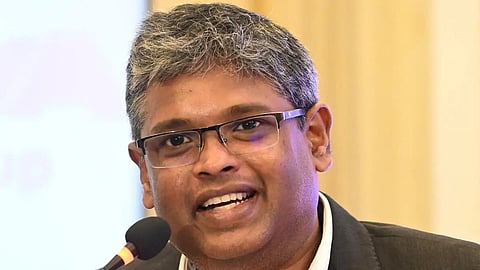

CHENNAI: The state government’s decision to replace higher education secretary V Arun Roy with Dheeraj Kumar just two months after the former’s appointment has renewed concerns over the extraordinary bureaucratic churn in a department already battling with a plethora of academic challenges.
With the latest reshuffle, Dheeraj Kumar becomes the eighth higher education secretary in the last three years, a trend which has triggered concern among academicians as the frequent transfers have crippled policy continuity and delayed critical reforms.
The frequent change in guard assumes significance as it comes at a time when several state universities continue to function without vice-chancellors, apart from unfilled faculty vacancies, pending career advancement scheme benefits, controversy over Teachers Recruitment Board’s assistant professor recruitments, and drop in national and global rankings.
Since July 2023, D Karthikeyan, A Karthik, Pradeep Yadav, K Gopal, C Samayamoorthy, P Shankar and V Arun Roy have held the post before Dheeraj Kumar.
“The issue is not the capability of IAS officers. They are trained to adapt quickly,” said a former V-C, requesting anonymity. “But by the time a secretary understands the department’s problems, identifies priorities and begins implementing solutions, another transfer order arrives. Higher education reforms require continuity, not constant disruption.”
Teachers’ associations argue that the frequent changes have left key policy decisions in limbo. Adding to it, the higher education secretary also heads the convenor committee for state universities functioning without V-Cs.
C Murugan, general secretary of the Madras University Teachers Association (MUTA), said repeated transfers have compounded the administrative vacuum.
“When many state universities are already without V-Cs, changing the higher education secretary frequently only weakens governance and leaves institutions without direction,” he said. “We appeal to the government to retain the new secretary at least till the V-C appointment problem is solved,” added Murugan.
Academician SP Thyagarajan pointed out that the higher education secretary is the crucial link between the state government, universities and the centre, overseeing everything from appointments and funding to academic reforms and quality improvement. “While transfers are routine in the civil service, eight secretaries in three years is anything but routine and the cost is now being borne by state universities, where policy paralysis has increasingly replaced policymaking,” added Thyagarajan.
