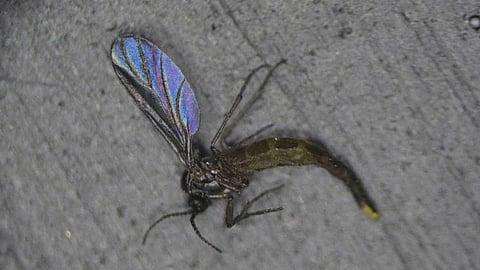

NILGIRIS: A team of researchers, after carrying out a field study in Selas and nearby villages, has identified the insects that recently swarmed the area as black-winged fungus gnats belonging to the Sciaridae family.
The research team, comprising A Samson, A Abinesh, Azad Kamil, N Sadiq Ali, N Moinudheen, Mohammed Shahir E Vignesh and F Suhaib Yatoo from the Wildlife and Nature Conservation Trust (WNCT) and Ongil Nature Trust, found that the flies pose no threat to humans as they do not bite, sting or inject venom.
“These flies do not pose a direct threat to humans, though they are common during this season. Their life cycle lasts between 21 and 28 days, during which a female lays 100 to 200 tiny eggs. They typically lay their eggs in damp soil and decaying organic matter,” said Mohammed Shahir, who visited the Selas area as part of the study.
“We observed high concentrations of these flies in the central town, along Upper Road and the Downhill Road stretch. They were particularly prevalent in the town centre and tended to congregate near water sources,” he said.
After a week-long continuous fogging operation, the black fly menace in Aravenu near Kotagiri has been brought largely under control. The flies had been causing inconvenience to residents for more than a week by invading houses and disturbing walkers and motorists. The sustained fogging drive carried out by the Kotagiri Municipality with the assistance of sanitary workers from neighbouring village panchayats significantly reduced the fly population, bringing relief to the public.
Villagers said that the infestation reportedly began in Kottacombai village before spreading to neighbouring Aravenu and a few surrounding villages. While locals said this was the first such infestation in the Aravenu region, they recalled a similar incident reported in Ulikkal village about 12 years ago.
“If we switch off the lights, the flies go away on their own. We are still keeping our water tanks covered and making sure that garbage is not left outside even for a day to avoid attracting them,” Boopathy, a resident of Aravenu, said.
“These flies are strongly attracted to white shirts and often land on them. They also get into people’s eyes, causing irritation, redness and discomfort, which has created distress among residents,” said E Vignesh.
N Moinudheen said “To reduce the proliferation of these flies, it is sufficient to identify their breeding sites and clean those areas. Furthermore, since the destruction of rove beetles can exacerbate the problem, reducing the use of chemical fertilisers helps preserve these beneficial predator species.
Meanwhile, Kotagiri Tahsildar S Mahendra Kumar said the administration had brought the situation under control by deploying 10 teams exclusively for fogging operations. “We also deployed an ambulance to examine people. However, no infections have been reported,” he said.
