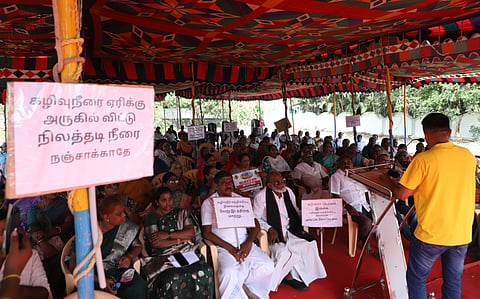

COIMBATORE: More than 300 people, including farmers, local residents, environmental activists, industrialists, educators, students and children, staged a one-day hunger strike at Chinnavedampatti on Saturday, intensifying opposition to the Coimbatore City Municipal Corporation's (CCMC) proposal to establish a sewage treatment plant (STP) on the bund of Chinnavedampatti lake as part of the underground drainage (UGD) project.
The protest comes after months of demonstrations against the project, with residents alleging that the civic body has continued the construction despite repeated objections from the local community. The proposed STP is being executed by the Tamil Nadu Water Supply and Drainage (TWAD) Board on behalf of the CCMC to cater to the underground drainage network in Kavundampalayam, Thudiyalur, Vadavalli, Veerakeralam, Saravanampatti and Vellakinar.
According to the corporation, the facility will treat nearly 19 million litres of sewage per day using tertiary treatment technology, making it the city's first plant of its kind. The treated water is proposed to be discharged into Chinnavedampatti lake to augment water availability, improve groundwater recharge and reduce dependence on freshwater resources. Officials have maintained that the treated water will meet prescribed environmental standards and cited similar projects in other cities as successful examples of wastewater reuse.
However, the assurances have failed to convince residents and environmental groups, who argued that the Chinnavedampatti lake is one of the few remaining freshwater lakes in the region and should be protected from any form of treated sewage discharge.
"The lake was created specifically to harvest rainwater, support irrigation, recharge groundwater and mitigate floods. The state government acquired 170 acres of agricultural lands in 1986 under the Land Acquisition Act, 1894, exclusively for establishing the irrigation reservoir. Using the acquired land for a permanent structure such as an STP would be contrary to the original purpose for which the land was acquired," said Muthusamy, a farmer.
Residents recalled that during a public consultation meeting held on March 6, 2023, the CCMC had initially proposed constructing the STP near the Chinnavedampatti crematorium. Following opposition from nearby residents, they alleged that the project was shifted to the lake instead.
They also expressed concern over the corporation's track record in maintaining STP facilities. They claimed that several lakes handed over to the corporation for maintenance continue to suffer from sewage pollution and alleged that existing treatment plants do not function effectively. They fear that, despite assurances of advanced treatment technology, treated sewage could eventually be released into the lake, affecting groundwater, agriculture and the fragile ecosystem.
Speaking to TNIE, V S Kalisamy, president of the Chinnavedampatti Lake Protection Association, said the association, along with local residents and environmental activists, would continue to oppose the project. "Chinnavedampatti lake receives water through the Sanganoor canal, which is fed by 112 streams and four major channels originating from the Western Ghats, making it a vital freshwater source for groundwater recharge, irrigation and drinking water needs in the region. We urge the CCMC to locate the STP at the originally proposed solid waste transfer station site instead of the lake."
Protesters further contended that Chinnavedampatti lake remains the only lake in the district with the potential to receive freshwater from the Western Ghats in the future and argued that preserving its natural character is essential for long-term water security. Except TVK, the ruling party, representatives from all major political parties, including the DMK, CPI, CPM, AIADMK, NTK, BJP and other parties, took part in the hunger strike and supported the cause.
The protesters also cited Condition No 17 of the state government's GO (4D) No 50, dated May 30, 2025, issued by the water resources department, which provides for cancellation of permission granted for establishing the STP if there is public objection to the project. Despite sustained opposition from farmers, residents and environmental groups, the CCMC has continued with the works, prompting the community to intensify its agitation through the hunger strike.
CCMC Commissioner Katta Ravi Teja didn't respond to TNIE's calls for a comment.
Speaking at a presser after inaugurating four new indoor sports arenas in the city later in the day, Backward Classes Welfare Minister V Sampath Kumar said the STP will not cause any harm and that an awareness campaign is being conducted to inform the public regarding the benefits of the project.
"It is a good project. As for decentralization of the work, sewage collected here will be treated in the same area, and will not cause any inconvenience to the local residents. Treating sewage in the respective areas is the right approach, we cannot take our sewage to another district or state. Some people are opposing the project without understanding it properly, and the awareness campaigns are aimed at them. As a next step, we can make the treated water as clean as drinking water," the minister told reporters.
(with inputs from R Kirubakaran @ Coimbatore)
